This weeks Chiplet Summit is making something clear: Disaggregation is no longer theoretical. AI workloads — from hyperscale training clusters to edge inference systems — are pushing beyond what monolithic SoCs can economically sustain.
Subcribe to our blog series here: AI TechSales Blog AKA The Watchtower Brief
We are entering a new architectural era.
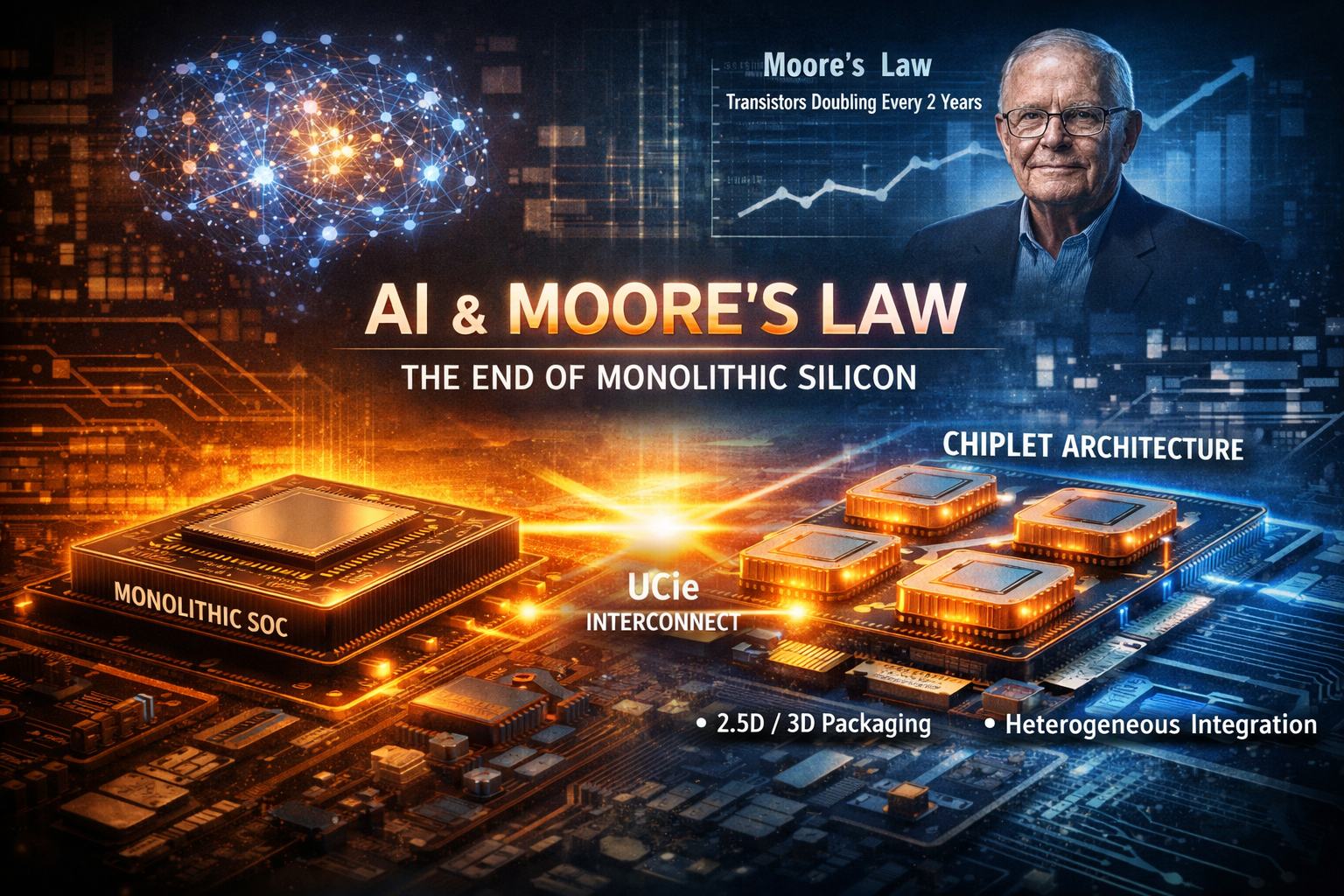
Chiplets, enabled by UCIe, are becoming the structural response to AI-driven compute demands.
But this shift isn’t driven by AI alone. It is also the next chapter of Moore’s Law.
In 1965, Gordon Moore observed that the number of transistors on a chip would double on a regular cadence while the cost per transistor would fall. That observation became the roadmap for the semiconductor industry for decades.
For years, scaling meant packing more transistors onto a single, ever-larger die.
But as physical limits tighten and economic scaling becomes more complex, simply shrinking transistors is no longer sufficient to maintain Moore's cadence.
The industry has responded by shifting from monolithic scaling to system-level scaling — leveraging advanced packaging and heterogeneous integration to assemble multiple optimized dies into a unified system.
Chiplets are not a break from Moore’s Law.
They are its architectural evolution.
Instead of asking, “How small can we make a transistor?”
We are now asking, “How intelligently can we assemble silicon systems?”
This transition may significantly expand the semiconductor industry over the next five years.
But the real story isn’t just market size. It’s system integrity.
When we move from a single die to multiple interconnected dies — potentially across different process nodes, vendors, and packaging technologies — the system boundary shifts. The interconnect becomes foundational. And that introduces new layers of complexity:
• Signal integrity across dies
• Power integrity at high bandwidth
• Cross-die protocol validation
• Latency and determinism requirements
• Thermal and reliability constraints
• Integration across advanced packaging (2.5D / 3D)
Traditional EDA and IP ecosystems were optimized for monolithic integration.
Disaggregation challenges those assumptions. Monolithic-era business models were built around vertically integrated SoC design:
• The interconnect lived inside a single die
• Validation assumptions were centralized
• Integration occurred within tightly coupled tool flows
• Vendor alignment followed the boundaries of the die
Chiplets change those boundaries. When dies are developed across different nodes, suppliers, and even geographies, the interface is no longer internal plumbing — it becomes the foundation of system cohesion. That shift changes the risk profile. In a disaggregated ecosystem, UCIe IP must be:
• Node-flexible
• Packaging-aware (2.5D / 3D / advanced substrates)
• Silicon-proven across heterogeneous integration contexts
• Designed for interoperability across diverse tool chains
• Architected with long-term modularity in mind
In this environment, independence and interoperability matter. Organizations must ask whether their interface IP strategy is aligned with legacy monolithic assumptions — or built for an open, multi-die future. The chiplet world rewards modularity. It also exposes hidden coupling.
That’s why the quality, portability, and integration philosophy behind UCIe IP are becoming strategic decisions — not just procurement choices.
This is why we are spotlighting InPsytech.
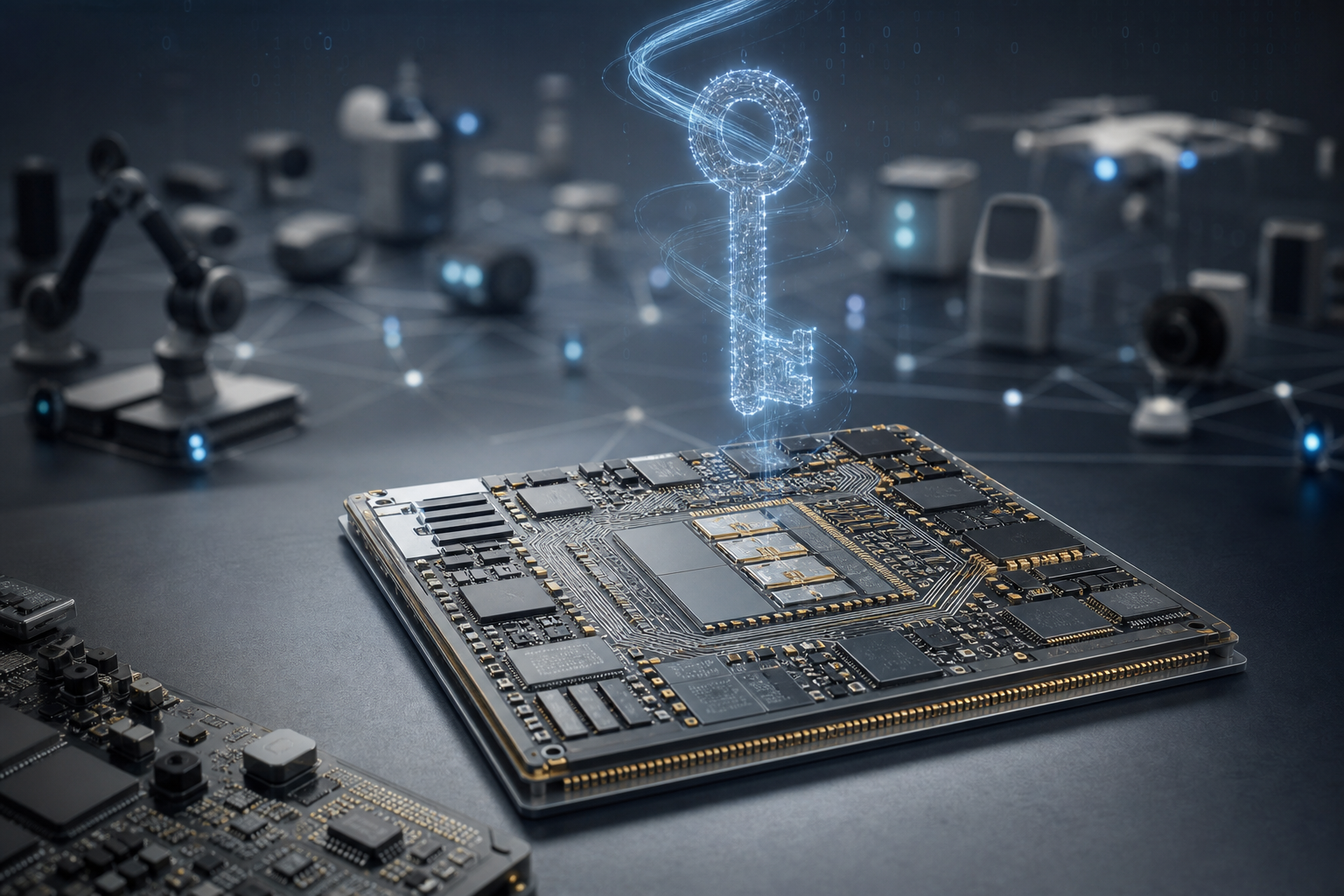
InPsytech develops high-speed interface IP — including UCIe (PHY + controller) — engineered for high-performance chiplet systems. Their focus is on enabling robust, reliable die-to-die connectivity across advanced packaging architectures.
As AI systems scale and heterogeneous integration becomes mainstream, the margin for interconnect failure shrinks.
Bandwidth increases.
Power density rises.
Validation complexity multiplies.
Design integrity becomes the differentiator. The companies that solve these integration challenges will shape the next decade of computing.
On February 25 at the Computer History Museum, we’re bringing together leaders building in this new chiplet-enabled era.
If you’re working at the intersection of AI, silicon architecture, advanced packaging, or high-speed interface design — this conversation is worth your attention.
👉 RSVP here:
https://www.ai-techsales.com/aitech-sales-client-launch-computer-history-museum-mountain-view-ca
👉 Learn more about InPsytech and the companies shaping the next semiconductor stack:
https://www.ai-techsales.com/clients
Over the coming days, we’ll spotlight additional companies driving this architectural transition.
The age of monolithic silicon is ending.
The age of integrated chiplet systems has begun.
Subscribe to our blog series here: AI TechSales Blog AKA The Watchtower Brief