An AI TechSales Watchtower Brief
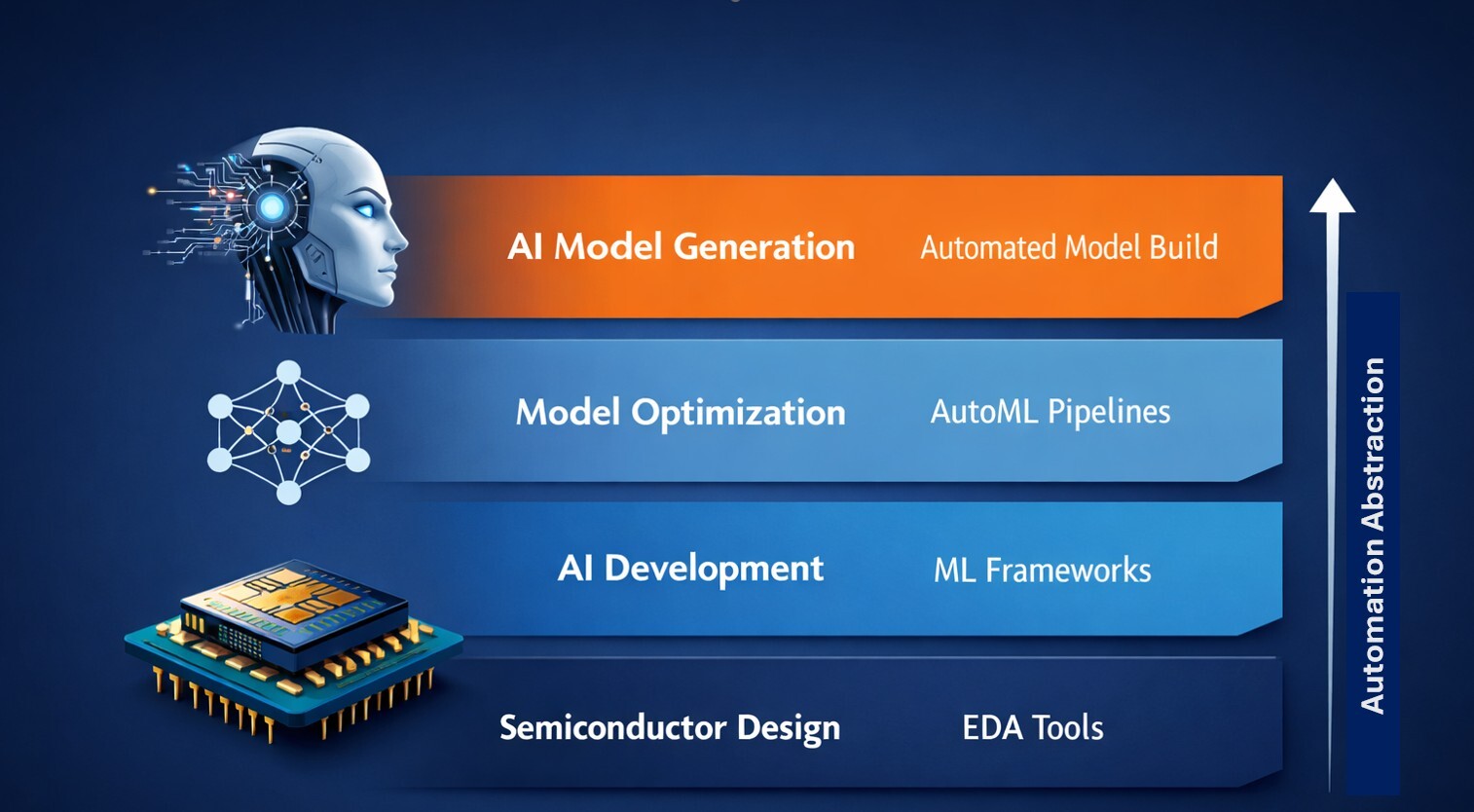
The semiconductor industry solved a problem decades ago that AI engineering is only now beginning to face. Managing the complexity of validation. Modern chips contain billions of transistors, yet no engineer designs them transistor by transistor anymore. Instead, semiconductor design relies on a powerful stack of abstraction layers:
Transistors → Logic → RTL → System Design → Verification → Tapeout.
Each layer enabled the creation of systems previously unimaginable. Without Electronic Design Automation (EDA), modern semiconductor design simply wouldn’t exist. Today, something similar is beginning to happen in the field of artificial intelligence.
The Growing Complexity of AI Systems
Training a machine learning model used to be a relatively straightforward process.
Choose an architecture.
Train it on data.
Deploy the result.
But that simplicity disappeared quickly as AI began moving into real products. Especially products that live outside the cloud. Consider what it takes to deploy AI inside an embedded device:
• selecting the right model architecture
• tuning hyperparameters
• compressing networks
• quantizing weights
• validating performance
• optimizing inference speed
• fitting within strict memory limits
• minimizing power consumption
And that’s before considering hardware diversity. The same model may behave very differently across:
• microcontrollers
• embedded GPUs
• AI accelerators
• heterogeneous SoCs.
In practice, deploying AI on real devices often turns into a long cycle of trial and error.
The Hidden Engineering Loop
Many AI teams experience the same workflow. Data scientists build a model. Embedded engineers attempt to run it on hardware. Then the iteration begins.
Model too large? Compress it.
Inference too slow? Change architecture.
Power consumption too high? Try quantization.
Each adjustment requires retraining, testing, and validation. For embedded AI systems, these loops can repeat dozens or even hundreds of times. The result is that model development becomes less about innovation and more about searching an enormous design space. Which should sound familiar to those of us who have developed our careers in SOC design and EDA. We have faced the exact same problem.
When Design Spaces Explode
Before modern EDA tools existed, chip designers manually explored architecture choices.
Gate configurations.
Timing tradeoffs.
Layout constraints.
But as chips became more complex, manual exploration became impossible. The solution was automation. EDA tools began to automatically search design spaces, optimize trade-offs, and verify system behavior. That shift didn’t remove engineers from the process. It gave them leverage. AI engineering is approaching the same moment.
The Emergence of AI Model Automation
Instead of manually designing and optimizing models, a new category of tools is beginning to automate the entire process. These platforms automatically explore model architectures, train and evaluate them, and test their behavior against real system constraints. Rather than engineers iterating through design choices themselves, the system performs that exploration autonomously. In effect, the tool becomes responsible for navigating the model design space. The result is a workflow that looks less like traditional machine learning and more like EDA for AI models.
Hardware Becomes Part of the Loop
One of the key lessons from semiconductor design is that optimization cannot happen in isolation. A chip design that works in simulation may fail when timing, thermal constraints, and manufacturing realities are taken into account. AI systems face a similar challenge. A model that performs well in a training environment may perform poorly when deployed on real hardware.
Latency increases.
Memory usage spikes.
Power consumption rises.
Which means optimization needs to occur in the context of the target device. This is where a new generation of platforms, including ModelCAT, is focusing attention.
Bringing Hardware into Model Creation
ModelCAT approaches model development as a hardware-constrained optimization problem. Instead of starting with a predefined architecture, the system generates candidate models automatically and evaluates them against the constraints of the target device. The platform can:
• generate architectures
• train models
• measure accuracy
• evaluate inference performance
• iterate until it finds an optimal design
Importantly, this process incorporates real hardware feedback, allowing the system to optimize models for the environments where they will actually run. For teams building edge AI systems, this can significantly reduce the manual experimentation that traditionally dominates model development.
A New Layer in the AI Stack
Seen through a historical lens, the direction is clear. AI development is moving toward a layered stack similar to the one that emerged in semiconductor design. Raw compute → Frameworks → Model architectures → Automated model generation → Deployment. Each new layer abstracts away complexity, enabling engineers to focus on higher-level system design. Model generation platforms represent the next step in that evolution.
Why the Timing Matters
The need for automation is being driven by the rapid expansion of AI into physical systems.
Robotics.
Industrial automation.
Smart sensors.
Automotive systems.
Consumer devices.
These environments impose strict constraints that traditional AI workflows struggle to manage efficiently. As billions of intelligent devices come online, manual model optimization simply won’t scale. Automation becomes inevitable.
The Watchtower View
History suggests that whenever a technology becomes complex enough, a new abstraction layer eventually appears to manage it. Semiconductor design reached that point decades ago with EDA. AI engineering may now be approaching a similar transition. Instead of engineers manually designing every model, the systems themselves may begin generating optimized models automatically. If that happens, the next decade of AI infrastructure could look very different from the last. And platforms like ModelCAT may represent the early signals of that shift.
Subscribe to The Watchtower Brief for more insights at the intersection of AI infrastructure, semiconductors, and emerging technology ecosystems.