The license price was never the real cost driver. The absence of an owner is.
Simon Bennett, Principal Solutions Consultant and Co-Founder · September 20, 2026
A conversation we hear on repeat, at companies large enough that no single person can see the whole board: someone in procurement expresses interest in a new EDA capability. A parallel conversation opens with a senior engineering leader, who pushes back. Not because the tool is wrong, but because of who is asking. "We already have a solution," he says. Then, almost as an aside: "EDA spend forecasting is something engineering owns, not procurement."
It is a small sentence, and it is doing a lot of work. It tells you that ownership, not evaluation, is the actual gate you have hit. And in a market where tooling decisions ripple across a $1T semiconductor value chain, ownership is rarely as tidy as an org chart implies.
The question behind the question
The instinct, when someone claims ownership of a forecast, is to take the claim at face value and move on. The more useful instinct is to ask a narrower question: for the whole company, or for this team?
That single clarification tends to produce one of three answers, and each one tells you something different about how the organization actually spends money on EDA:
- "We meet and roll up our needs." Worth pressing further: is the forecasting method standardized across groups, who owns the governance of it, and who actually delivers the roll-up? Often the honest answer is that the meeting exists, but the standard does not.
- "We each deal directly with the EDA suppliers." This is the more common answer at scale, and the more expensive one. If every group owns its own vendor relationship, the natural follow-up is simple: how does anyone know the company, corporate-wide, is getting the best use of the tooling it already owns?
Neither answer is a rejection. Both are a map of where the real cost is hiding.
Why this is an EDA 3.0 problem, not a sales problem
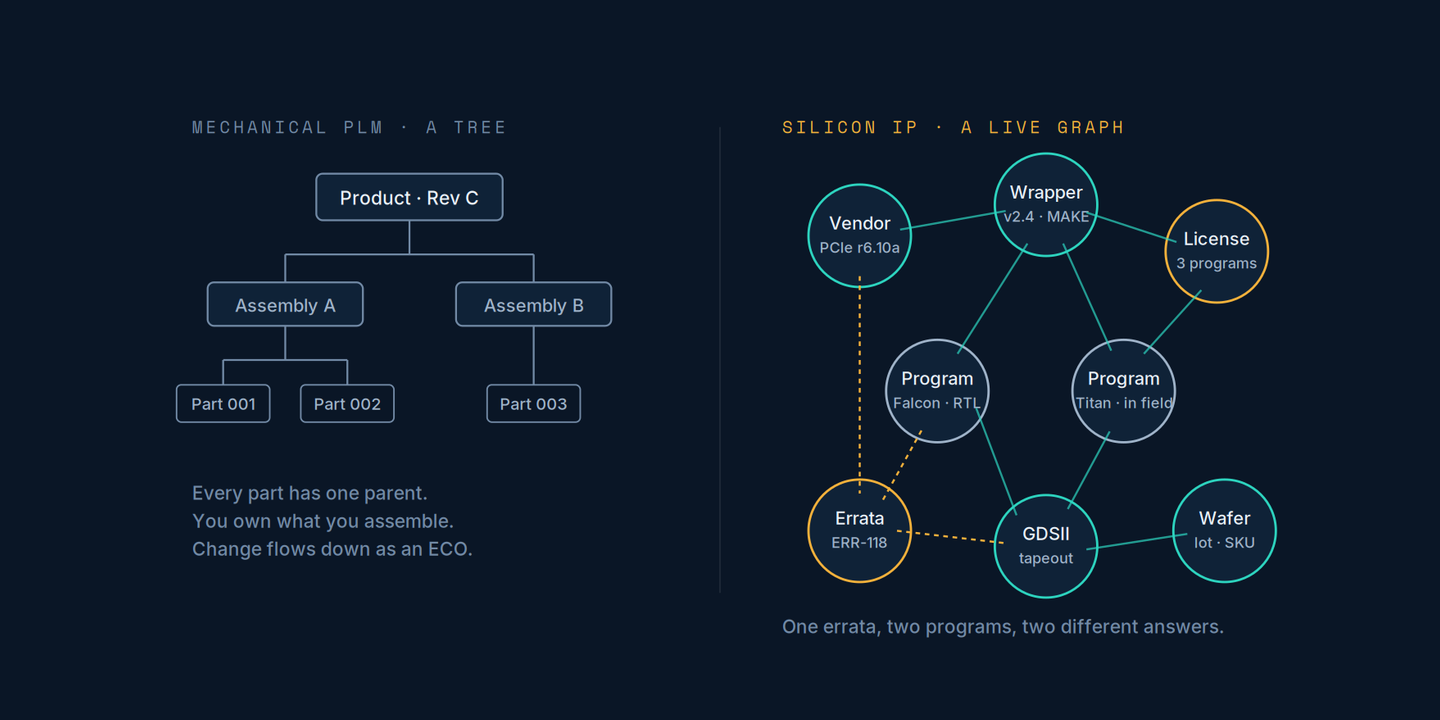
This fragmentation is not an accident of any one company's org design; it is a structural feature of the EDA 2.0 model. Tool-centric, siloed, human-driven decision-making optimizes each team's individual workflow and leaves no layer that owns the picture across teams. Utilization, renewal timing, and license overlap all live in the gap between groups, invisible to any single budget holder because no single budget holder is looking at the whole thing.
That gap is not a footnote to the EDA 3.0 thesis; it is the thesis. The incumbents already put AI inside the tool. What none of them own is the intent layer above it: the orchestration view that connects requirements through to yield and, along the way, actually answers the question every engineering leader assumes is already answered somewhere. Value in that world is not measured in tool speed. It is measured in outcomes: time to market, yield, margin, and just as concretely - whether the enterprise is paying for capability it cannot see and cannot govern.
The commercial lesson, not just the technical one
There is a second lesson here, and it has nothing to do with governance charts. When you find the person willing to describe what they actually do today and where it gets hard, that is the contact worth staying with. Expand outward once you have a real baseline for how things work; expanding before that only recreates the same ownership confusion you are trying to diagnose. Everyone has done this. The fix is not a smarter pitch. It is patience with the first honest conversation you get.
The economics of EDA are decided less by list price than by visibility: who can see total spend, who owns the standard, and who can say with a straight face that the tooling is being used well, corporate-wide. Until an organization can answer that cleanly, that invisible line is exactly where the budget leaks.
Further reading on this topic here: How EDA ROI Shapes Semiconductor Tool Decisions
AI Tech Sales · Watchtower Brief