EDA3.0
Verification

For decades, embedded systems have been built the same way. You start with requirements. You write code. You integrate against hardware. You debug. You iterate. And if you’re building something complex—robotics, autonomous systems, industrial edge devices—you repeat that loop for months. Sometimes years. This model has survived every wave of innovation:
But it is now running into a hard limit.
Modern embedded systems are no longer just firmware. They are:
The result is that development workflows can no longer keep up. A perception pipeline for a robot. A multi-camera edge AI deployment. An IoT device expected to adapt in the field. These are not static builds anymore. And yet we still build them as if they were fixed artifacts.
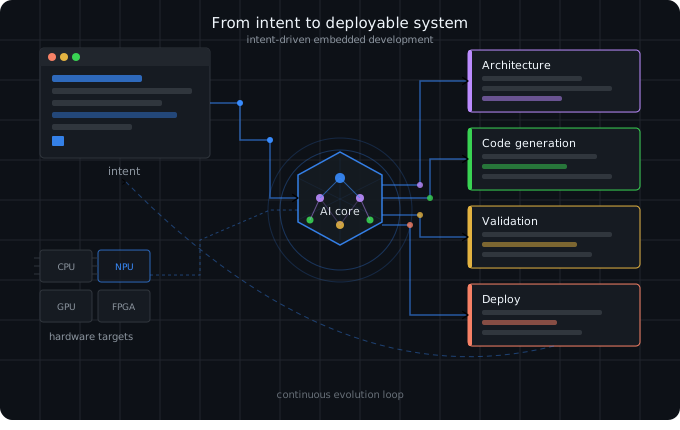
A different model is starting to emerge. Instead of beginning with code, engineers begin with intent. What do you want the system to do? What hardware is it targeting? What constraints matter—latency, power, memory, reliability? From there, the system is not manually constructed. It is generated. Not as snippets. Not as drafts. But as a full, deployable system:
In other words: From prompt to deployable system. This is not a coding acceleration. It is a workflow inversion.
At first glance, this sounds like an extension of what teams are already doing with GPT or Claude. It isn’t. Most teams experimenting with LLMs today are seeing modest gains—20 to 30% productivity improvements. Useful, but limited. Because those tools operate at the wrong layer. They generate:
But embedded development is not a code-generation problem. It is a systems orchestration problem. To move beyond incremental gains, three things are required:
This requires more than a model. It requires a system of agents, each responsible for a different stage of the workflow:
And critically, combining:
That combination is what turns generation into something deployable.
There is a second shift happening underneath this one. In the traditional model, firmware is treated as a project:
In reality, especially in edge AI and intelligent systems, firmware is becoming a continuously evolving layer of the product. New requirements can emerge after deployment:
Each of these triggers another development cycle. The difference in the new model is that this cycle is no longer manual.
The system:
Over time, it accumulates:
What emerges is something closer to a virtual firmware lab than a traditional toolchain.
This shift does not remove engineers from the process. It changes where they operate. From:
To:
It also changes how teams scale.
Today:
Tomorrow:
This matters for a simple reason: Most teams building embedded systems today are already experimenting with AI tools. But very few have turned that experimentation into a reliable development system.
The “code first” model will not disappear overnight. But it is starting to look like an intermediate step—not the foundation. As systems become more complex and more adaptive, the pressure to move upstream—from code to intent—will only increase. The teams that make that shift early will not just move faster. They will build systems that are:
Because they are no longer just writing software. They are generating systems.