
Chiplets and EDA
Watchtower Brief: Chiplet Ecosystems Are Tightening — But the Opportunity Is Moving Up the Stack

(If you like this content, click here to subscribe for more.)

Recent announcements from Cadence — alongside similar signals from Synopsys — have reignited a familiar concern across the chiplet ecosystem:
Are major EDA vendors building walled gardens that make it harder for smaller companies to compete or innovate?
The short answer is no — but the reason matters.
These moves are reshaping where value concentrates in chiplet programs and which capabilities become indispensable as execution accelerates.
What the EDA vendors are doing
Across partner programs, technical roadmaps, and ecosystem announcements, a consistent pattern is emerging.
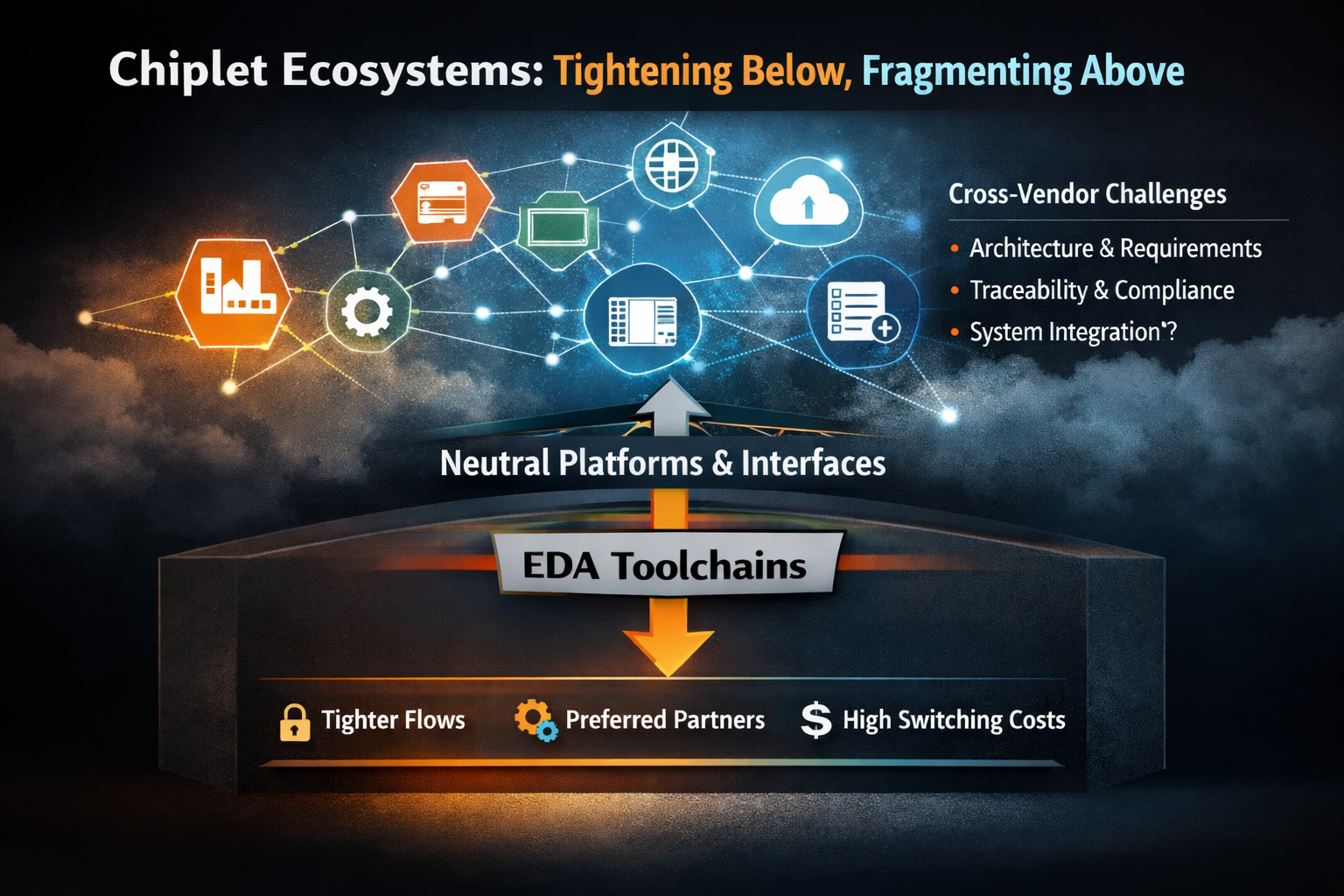
Cadence and Synopsys are:
-
Tightening execution inside their design, verification, and implementation flows
-
Encouraging preferred IP, foundry, and packaging partners
-
Reducing friction for teams that stay within a single ecosystem
-
Increasing switching costs at the EDA flow level
They are not:
-
Acting as neutral systems of record across companies
-
Governing architectural intent or decision rationale
-
Solving trust, compliance, or accountability across organizational boundaries
These are tighter execution environments, but are not closed, end-to-end platforms.
Why “walled gardens” is the wrong mental model
Chiplets change the nature of complexity.
They shift it:
-
From single-die optimization → system-level reasoning
-
From single-company flows → multi-company coordination
-
From tool correctness → decision traceability and trust
As EDA ecosystems accelerate execution within toolchains, they unintentionally increase fragmentation above the tool layers:
-
Architectural intent evolves faster than documentation
-
Requirements, interfaces, and evidence multiply
-
Ownership boundaries blur across vendors
-
Compliance obligations span organizations
The faster teams move inside EDA, the harder it becomes to reason across tools, companies, and lifecycle stages.
What this means for smaller, independent companies
For companies that complement or compete alongside large EDA vendors, the implication is counterintuitive:
Tighter EDA ecosystems increase demand for neutral, cross-vendor capabilities — not less.
Where opportunity grows:
-
Above execution — maintaining intent, rationale, and coherence as velocity increases
-
Across organizations — enabling traceability, accountability, and evidence across companies
-
At standards boundaries — interoperable components that work across flows and packaging choices
-
Upstream of commitment — helping teams explore system-level tradeoffs before decisions are locked in
-
At the trust layer — proving correctness, safety, and compliance across distributed programs
These needs are amplified, not reduced, by faster execution environments.
The takeaway
Cadence and Synopsys are accelerating how fast chiplets get built.
In doing so, they are:
-
Increasing fragmentation in the tool and design layers above where EDA traditionally sits
-
Increasing organizational and program complexity
-
Increasing the importance of neutral platforms that operate across tools, vendors, and lifecycle stages
This is a great opportunity for companies and specialists who complement traditional EDA and IP integration flows. Synopsys and Cadence are doing their part to make the next phase of Semiconductor design as exciting and challenging as ever.
(If you like this content, click here to subscribe for more.)
