FPGAs deliver design flexibility. They also give you the longest, most specialized, and least forgiving development cycle in the building. For most teams, that trade is the whole problem. When a workload demands deterministic latency or raw throughput (signal processing, custom acceleration, line-rate networking, real-time control), an FPGA is often the right answer on paper. In practice, the cost of getting from idea to deployed logic is high enough that many teams avoid it, over-provision a GPU instead, or wait months for a small pool of HDL specialists to free up.
The FPGA Tax
Every FPGA design carries a tax that has barely changed in twenty years:
- write RTL in Verilog or VHDL, by someone who knows the device family
- simulate and verify the logic against a testbench
- synthesize, then place and route into the fabric
- iterate on timing closure until the design actually meets constraints
- generate, test, and sign off the bitstream
Each step demands scarce expertise, and each retarget (a new device, a new speed grade, a tweaked requirement) sends you back through most of the loop. The talent that can do this well is expensive and in short supply, which makes the FPGA the part of the system everything else waits on.
Design Blocks Are the Real Unit of Work
Most FPGA development is not inventing logic from nothing. It is assembling and adapting design blocks (DMA engines, filters, FFTs, bus interfaces, custom accelerators) and wiring them into a system that meets timing on a specific device. The blocks are reusable in theory. In practice, moving a block to a new device or a new clock target means re-verifying it, re-timing it, and re-building it. The unit of work is the block, but the block does not travel cleanly. So the same engineering is repeated across projects that are structurally almost identical. A copilot can autocomplete Verilog. It cannot close timing. The bottleneck in FPGA development was never the syntax: it is everything between valid RTL and a bitstream that meets constraints on real silicon.
Where Copilots Stop
This is the same wall we described in Why Copilots Don't Work for Embedded Systems. A copilot operates at the level of a line or a function. FPGA development fails or succeeds at the level of the system: how blocks compose, whether the placed-and-routed design meets timing, whether the bitstream is correct on the target. Suggesting the next line of HDL does not move that needle. The work that consumes the schedule sits above the code, and that is precisely where line-level assistance has nothing to offer.
From Intent to Bitstream
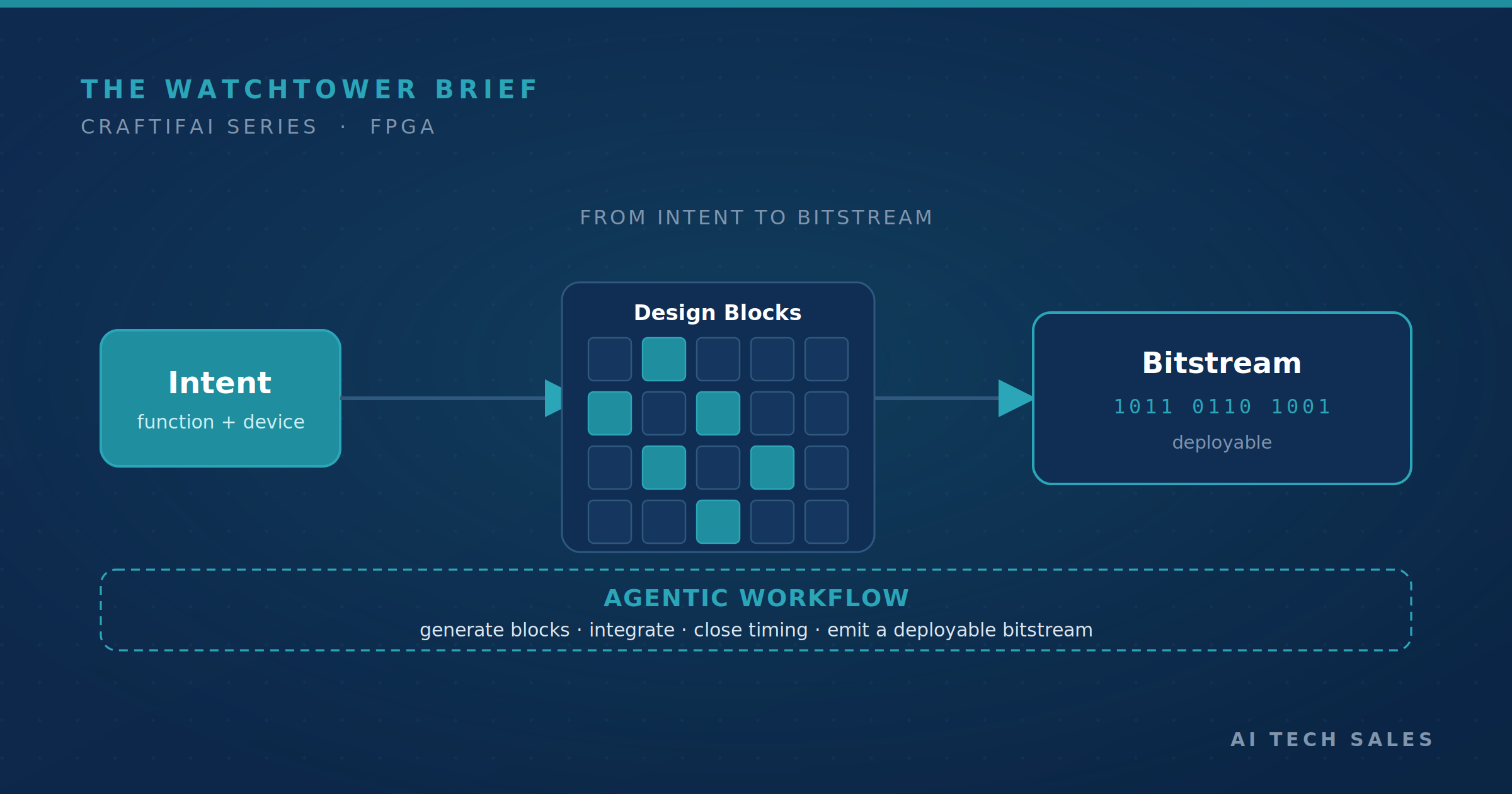
The alternative is to treat the whole cycle as something to generate rather than grind through. Imagine being able to:
- declare the function you need, the target device, and constraints
- have the required design blocks generated and integrated
- have the design validated and timing closed against that device
- and receive a deployable bitstream as the output
That is the prompt-to-production model applied to programmable logic: intent in, a tested bitstream out, regenerable the moment the target or the requirement changes.
This Is What CraftifAI's AgentIQ Does for FPGA
CraftifAI's AgentIQ applies its agentic workflow directly to FPGA development, automating the path from a stated design intent through design-block generation and integration to deployable bitstreams. Rather than a single model guessing at HDL, specialized agents handle the stages that actually carry risk: composing blocks, mapping to the device, and validating the result. Because the workflow is driven by intent and target, the design is not locked to a single device. Retargeting becomes a guided migration step rather than a fresh multi-week project. AgentIQ handles the top-level wrapper, extracts only the required pin constraints from the board's master constraints file, and applies the minimal subsystem-level changes needed to support the target device and endpoints, leaving the team's scarce HDL expertise free for genuinely novel logic.
Why This Matters
FPGA capability has always been gated by talent and time. That gate is why so many systems that should use programmable logic never do. Compress the cycle, make design blocks and bitstreams something a team can generate and re-target on demand, and the calculus changes. The FPGA stops being the bottleneck that everything waits on and becomes a tool the whole team can reach for.
Closing Thought
For decades, using an FPGA meant accepting a development cycle measured in specialists and months. The teams that move first on intent-driven, agentic flows will get the performance of programmable logic without paying the full tax for it, and they will be re-targeting designs in the time it used to take to schedule the kickoff meeting.
Part of the CraftifAI series on The Watchtower Brief: signals, strategy, and hard-earned lessons from the front lines of AI and semiconductor go-to-market. Learn more about CraftifAI.