
ICTK
PUF


If you’re leading technology at an enterprise right now, you’re probably feeling two things at once: real pressure to move on AI, and a growing list of reasons why moving fast is harder than it looks. The direction — AI that can reason and act across your operations — everyone agrees on. The path to actually getting there is where things get complicated.
Most teams decide to build their own AI infrastructure. That instinct makes sense — your data is sensitive, your workflows don’t fit neatly into someone else’s template, and vendor platforms have a way of promising integration while delivering another system you have to manage.
The part worth thinking through: does the time it takes to build it right actually match the window you have? MIT’s Project NANDA found that despite $30–40 billion in enterprise GenAI investment, 95% of organizations are seeing no measurable bottom-line impact — and in our experience deploying GenAI across enterprises, the friction is rarely the models themselves. It’s governance: who can use what, on which data, with what audit trail. And data residency: hard legal requirements that prevent data from leaving your own infrastructure. Both get underestimated at the design stage and retrofitted later. That’s a useful thing to know before you’re 9 months in.
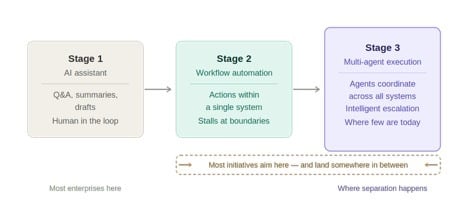
Here’s a pattern that comes up a lot: teams scope their build for Stage 3 and land in Stage 2. Not because of skill — the scope just expands the deeper you go, and timelines move with it. Meanwhile, 57% of organizations already have AI agents handling multi-stage workflows in production (LangChain State of Agent Engineering 2026, 1,300+ professionals surveyed). The gap is a competitive one: while your internal build is still in progress, others are already running. They’re making decisions on live data while you’re working from yesterday’s. They’re processing contracts in hours while your team is still reviewing manually. Every month the build extends, that distance grows — and it’s getting wider.
Getting to production reliably comes down to five things that are easy to underestimate early. Each one looks manageable on its own. Together, they’re usually what separates a working pilot from something your team can actually depend on.
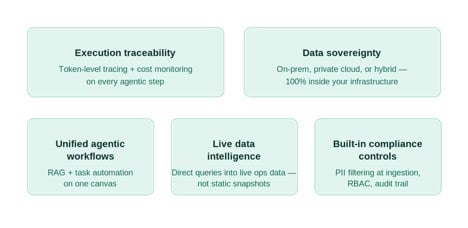
Tools like Microsoft Copilot, Salesforce Einstein, and Google Workspace AI are designed to work within the platform they come with. When a workflow crosses into a system they don’t control — your ERP, your fab systems, your proprietary data — the orchestration stops. Building that cross-system layer yourself is a valid path, but worth going in clear-eyed: typically 3–5 FTEs, 6–12 months before a first production agent, and $400K–$800K per year in ongoing maintenance. If the infrastructure itself is your competitive edge, that investment makes sense. If the value is in what the AI does rather than how it’s wired together, the math looks different.
Stage 3 can feel theoretical until you see it running somewhere specific. Here’s what it looks like across a few verticals where it’s already in production.
In financial services, treasury teams are watching real-time credit exposure across counterparties — agents querying live data directly, not yesterday’s snapshot — flagging breaches and surfacing rebalancing options before anyone would have caught it manually. The shift is from reacting to problems to getting ahead of them.
In legal, contract reviews that used to take weeks are getting done in hours. Agents flag non-standard clauses, catch compliance gaps across jurisdictions, and surface options across hundreds of agreements at the same time.
In healthcare, clinical documentation is being generated live from patient encounters, with diagnosis codes suggested in context — not in a test environment, in actual clinical use. In manufacturing, yield, scheduling, and quality are being monitored and adjusted in real time across multiple variables. In patent intelligence, a global platform is handling multilingual document comparison at a scale no off-the-shelf tool was built for.
What these deployments have in common: everything runs inside the customer’s own infrastructure — no data leaving the building, no dependency on a vendor’s cloud — with token-level tracing, cost visibility, and full audit logs on every run.
All of these deployments are built on Needle, an enterprise AI platform developed by Softweb Solutions (an Avnet company). Unlike built-in AI tools that process data through their own cloud, Needle deploys entirely within your infrastructure — your data never leaves your environment. It works across your existing systems regardless of who built them, supports any LLM you choose, and comes with governance, audit logging, and data residency controls built in from day one. The result is production-ready AI in weeks, not the 6–12 months a custom build typically requires.
The design phase is where the most expensive problems in semiconductor manufacturing are set in motion — often months before anyone knows they exist. By the time a yield issue surfaces in the fab, the root cause is usually a decision made at the design stage that no one had the data to question. That’s the gap agent-based AI is best positioned to close, because the data already exists. It’s just never been connected in a way that makes it queryable at the right moment.
Pre-tapeout risk prediction is the clearest example. Every design team has accumulated a history of rule violations, process node constraints, and yield outcomes across prior tape-outs — data that sits in EDA tools, PDKs, and post-silicon reports, disconnected from the design currently in progress. An agent running across that history can flag violations and risk patterns before the design goes to the fab, surfacing the kind of signal that today only shows up in a post-mortem. The cost of catching a timing closure issue or a DRC violation at design review is measured in days. The cost of catching it after mask commitment is measured in months and hundreds of thousands of dollars.
Power and thermal simulation follows a similar pattern. Hotspot risk and power density issues are predictable from historical chip data — the relationship between layout decisions and thermal behaviour is well-documented within a given process node. An agent with access to that history can flag high-risk layout regions early, before the full simulation run, giving engineers a directed starting point rather than a full-canvas search.
IP block reuse is where institutional knowledge quietly walks out the door. Most design organisations have built and qualified IP blocks across multiple programmes — standard interfaces, memory controllers, analog primitives — but finding them, verifying their reuse eligibility, and checking their qualification status across process nodes is manual work that often ends with engineers rebuilding something that already exists. An agent that indexes the portfolio and matches blocks to current design requirements turns that into a query instead of a search.
DFT optimisation and documentation are the unglamorous end of the design cycle — the work that happens after the creative decisions are made but before the design is handed off. Auto-generating test insertion coverage reports, datasheet sections, and design documentation from existing design files is exactly the kind of structured, repeatable, context-dependent task that agents handle well. The output isn’t creative; it just needs to be accurate and fast.
What these four use cases have in common is that the data required to do them well already exists inside your organisation. The bottleneck isn’t information — it’s the effort of connecting it, querying it, and surfacing it at the right moment in the design flow. That’s what the foundation is built to accelerate.
If any of this maps to a conversation already happening inside your organization, I'd welcome 30 minutes — your situation, a live look at what's already deployed, and if we can help you in any way.
Would you be open to connecting in the next two weeks?
 |
Sudeep Mehta is an Executive Technical Solutions Consultant at AI TechSales Inc. with nearly three decades of experience in the semiconductor industry and digital transformation initiatives. He helps semiconductor organizations leverage powerful new AI-era solutions to solve critical engineering and operational challenges.
|