EDA3.0
Verification
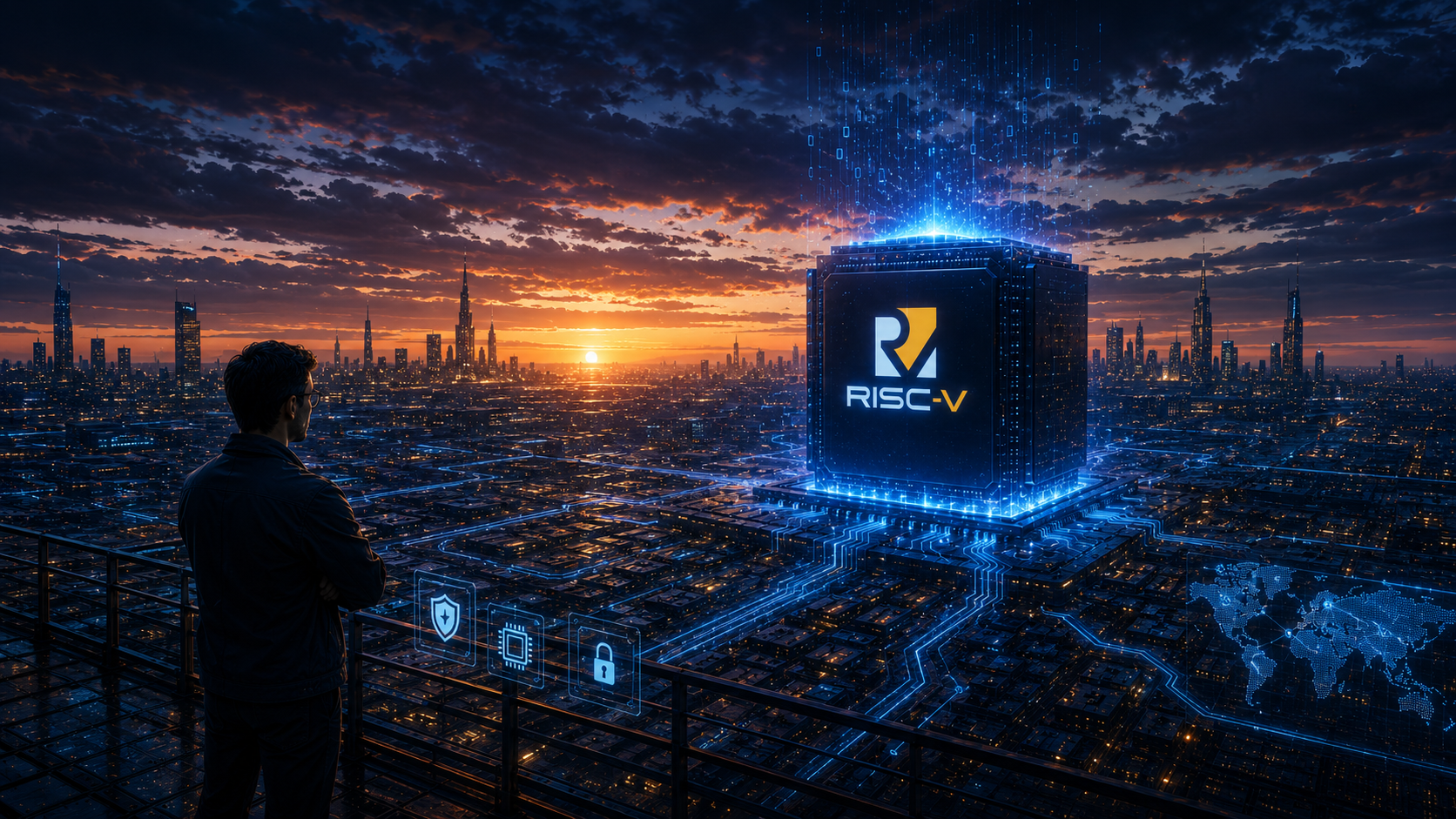

For a long time, I heard RISC-V discussed as one of the important shifts in processor architecture without really understanding why it mattered. I knew it was open. I knew it was gaining momentum. I knew it was often mentioned as an alternative to ARM. But the more I looked into it, the more I realized that the usual shorthand does not explain the real significance. RISC-V is not simply an open-source processor. It is an open instruction set architecture, and that distinction matters.
An instruction set architecture, or ISA, is the contract between software and silicon. It defines the instructions a processor understands and gives compilers, operating systems, firmware, and software tools a stable target. RISC-V makes that contract open. The specification can be implemented without paying royalties on the ISA itself or depending on a proprietary architecture owner. But the actual processor implementation, usually delivered as RTL, is something different. That implementation can be open source, internally developed, or commercial processor IP from a company like Akeana. In other words, the instruction vocabulary is open, but the quality of the processor still depends on the engineering behind the implementation.
That clarification changed how I think about RISC-V. The value is not that processor design suddenly becomes free or easy. It does not. Building a production-grade processor core is still hard. Performance, power, verification, software support, integration readiness, and long-term maintainability all matter. What RISC-V changes is where control sits. Instead of starting from a proprietary blueprint owned by someone else, companies can start from an open standard and then shape the processor around their own workload, product strategy, or sovereignty requirements.
That shift is becoming more relevant because the market around processors is changing. A recent signal was Akeana’s collaboration with Samsung Foundry to support server-class RISC-V SoCs and agentic AI CPU compute silicon. That is a very different conversation than RISC-V as a microcontroller or academic architecture. It suggests RISC-V is moving into the infrastructure discussion, where AI workloads, custom compute, and advanced-node silicon are creating demand for more configurable processor platforms.
This does not mean ARM or x86 are going away. x86 still anchors a huge base of enterprise and server software, and ARM remains one of the most successful semiconductor IP models ever built. ARM’s strength has been its trusted blueprint: a licensed architecture, a mature ecosystem, broad software support, and a commercial model that gave customers confidence. For many products, that model continues to make sense. If a company needs a proven applications processor with the broadest ecosystem, ARM is still a very strong answer.
But the same consistency that makes ARM powerful also limits how far customers can customize. A proprietary architecture owner has to protect ecosystem compatibility. Customers can configure within defined boundaries, but they cannot freely reshape the architecture around every proprietary workload. That matters more now because AI-era systems are becoming more heterogeneous and workload-specific. Inference, training, edge AI, sensor processing, robotics, datacenter acceleration, and custom control workloads do not all want the same processor. They may need different precision formats, vector behavior, memory access patterns, accelerator relationships, power envelopes, and software assumptions.
This is where RISC-V becomes more than a licensing alternative. It becomes a design freedom story. If a company is building an AI inference device, it may not want a general-purpose core carrying every floating-point feature. If it is building an edge AI product, it may want wide vectors in a smaller footprint. If it is building a chiplet-based system, it may need a configurable compute element that fits a specific system partition. RISC-V gives companies the architectural freedom to pursue those options. A commercial IP supplier like Akeana gives them a more practical path to implementation.
Akeana is interesting because it sits between the open standard and the production silicon problem. The company is not selling the RISC-V ISA. The ISA is already open. Akeana is selling high-performance, configurable processor IP built on that ISA, along with system IP such as interconnect, AI acceleration, IOMMUs, and interrupt controllers. Its internal positioning is not “free RISC-V,” but production-grade commercial RTL that customers can configure for specific workloads and integrate into their own chips.
That distinction is important because implementation is where the real work lives. A clean ISA does not automatically produce a strong processor core. It does not automatically produce coherent interconnect, subsystem integration, verification maturity, or a usable software environment. The open ISA creates optionality. The commercial implementation determines whether that optionality can become a real product. That is why companies pay for processor IP even when the underlying architecture is open.
The other force behind RISC-V is sovereignty. Semiconductor architecture is no longer a purely technical choice. Export controls, national semiconductor strategies, defense requirements, and regional technology independence initiatives have made processor dependency a board-level and government-level concern. If a chip program depends on a foreign-controlled architecture license, that dependency can become a strategic risk. RISC-V is attractive because no single commercial vendor owns the ISA, and the standard is governed outside the control of one processor company. This does not make every RISC-V implementation geopolitically neutral, but it does change the dependency model.
That sovereignty argument is one reason RISC-V is getting attention in custom AI silicon, automotive platforms, defense-adjacent systems, and national compute initiatives. The attraction is not just cost. It is control. Companies want the ability to build processors around their own requirements without waiting for a roadmap, negotiating architectural access, or accepting limits that were designed to preserve someone else’s ecosystem.
But openness creates a new problem. If anyone can implement the ISA, extend it, modify it, and configure it, then trust no longer comes automatically from the owner of the blueprint. In the ARM era, much of the trust came from centralization. The architecture owner validated the blueprint, protected compatibility, and maintained ecosystem discipline. In the RISC-V era, trust has to be engineered across the lifecycle.
That raises a different set of questions. What exactly was configured? Which extensions were added? Which units were removed? What requirements drove those decisions? How was the implementation verified? How does firmware stay aligned with hardware changes? How are variants governed across programs and customers? These are not abstract methodology questions. They are the practical questions that determine whether open, configurable processor IP can be trusted in production.
This is where the RISC-V discussion starts to connect with the broader EDA 3.0 story. If configurable processor IP becomes a more important part of the semiconductor landscape, then requirements management, IP lifecycle governance, firmware alignment, and formal verification become more important as well. RISC-V gives companies more freedom, but that freedom increases the need for traceability. Every extension, de-feature decision, and customer-specific variant becomes an artifact that must be specified, versioned, verified, and supported. The internal Akeana dossier makes this point clearly: a configured RISC-V core is not a static IP block; it is a managed artifact that changes with every customer engagement and every design decision.
This is also why formal verification becomes more central in the RISC-V era, not less. Simulation can sample behavior, but it cannot exhaustively prove every meaningful property of a configured processor core. When customers add custom instructions, remove functional units, or reshape execution behavior around a workload, the verification burden increases. That does not make RISC-V impractical. It means the trust model has to include rigorous proof, not just inherited confidence from a standard catalog core. In an open and configurable ecosystem, correctness has to be demonstrated for the specific implementation being used.
The strongest way to think about Akeana may be that it helps turn RISC-V from an open standard into usable commercial silicon IP. The company’s value is not that RISC-V exists. The value is that Akeana can provide engineered processor and subsystem IP that customers can shape around AI inference, edge compute, custom acceleration, sovereign compute, or chiplet integration. That is a different proposition from simply choosing a standard ARM core, and it is also different from downloading an open-source RISC-V core and taking on the full implementation burden internally.
The broader industry implication is that the blueprint is changing. In the previous era, the blueprint was largely architectural and proprietary. Trust came from the company that owned and maintained it. In the next era, the blueprint may be more operational. Trust will come from the system built around the processor: requirements captured clearly, configurations governed carefully, RTL verified rigorously, firmware kept aligned, and IP variants managed over time.
That is why I think RISC-V matters. Not because it automatically replaces ARM. Not because open always beats proprietary. Not because every company should build its own processor. RISC-V matters because it changes the control model for processor architecture at the same time AI, chiplets, sovereignty, and custom silicon are changing what companies need from compute.
Akeana matters because it is one example of how that shift becomes practical. It gives customers a commercial path to configurable RISC-V processor IP without requiring them to build everything from scratch. But the larger lesson is bigger than any one company. Open architecture creates freedom, and freedom creates responsibility. The companies that succeed in the RISC-V era will not simply be the ones that can modify a core. They will be the ones that can make those modifications trustworthy.
In the ARM era, trust came from ownership of the blueprint. In the RISC-V era, trust will increasingly come from traceability, verification, and lifecycle discipline. That may be the real inflection point.