chiplets
AI
AI Search


The Watchtower Brief
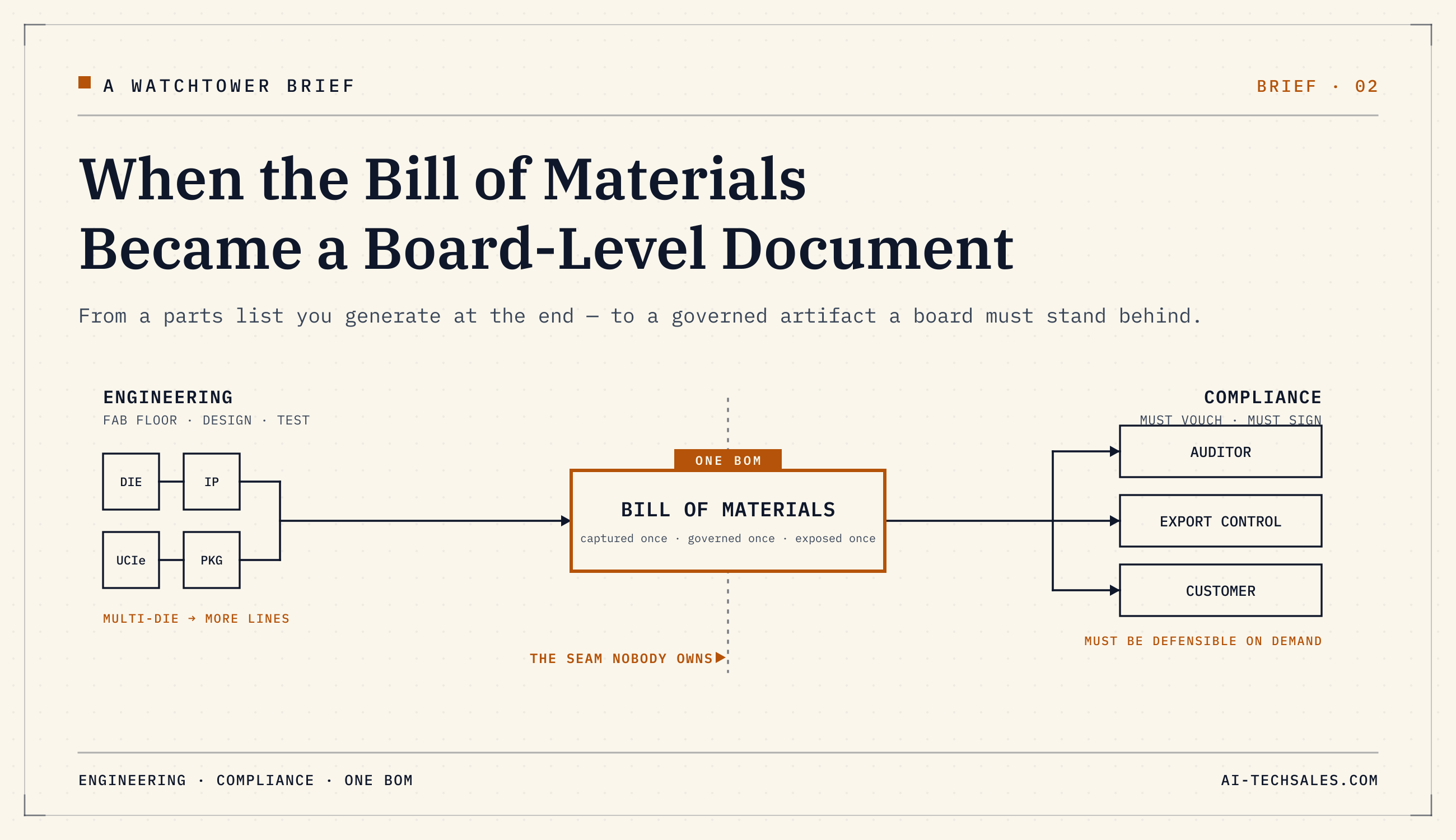
The first two parts of this series were about an artifact and a loop. The bill of materials becoming a governed source of truth a board has to stand behind. The field-to-engineering feedback path that turns what a product does in the wild into what you design next. Both assume something we have not yet argued for directly: that you can actually run AI over your most sensitive data — your design IP, your process recipes, your yield, your customers' field behavior — without shipping it to someone else's cloud or trusting a system you cannot see inside. That assumption is where most enterprise AI quietly dies.
The number that should worry anyone funding this work is that something like 85% of enterprise AI projects never reach production. The blocker is almost never the model. The models are extraordinary and getting cheaper by the quarter. The blocker is everything around the model: where it runs, what it is allowed to touch, whether anyone can audit what it did, and whether the bill at the end of the year is one you could have predicted. Those are not modeling problems. They are governance and deployment problems, and they are exactly the problems a frontier model does not solve for you.
Strategic Takeaway
The model is a commodity you can swap in an afternoon. The moat is the governed, private context you build around it — the agents that run on your own data, inside your own walls, with a full record of what they did. Buy the engine, not the model.
So why is this so hard, when the demos look so easy? Because the three obvious ways to get production AI all break in the same place — and they break quietly, a quarter or two in, after the budget is already committed.
For a single-stack organization, the cloud platforms are a genuinely reasonable first answer. They are easy to start, they are well integrated with the suite you already run, and they get a chat experience in front of people fast. The trouble is what happens at scale and at the edges. The deployment is the vendor's cloud, full stop — which is a hard wall the moment the data in question is process detail or yield or anything a customer made you sign an NDA over. The pricing is a per-seat licence stacked on a per-conversation or per-credit meter, so the cost grows with exactly the thing you are trying to encourage, which is usage. And the logic tends to stay simple and linear; the moment you need real retrieval over your own corpus joined to a multi-step task across other systems, you are fighting the tool. None of this is a knock on the platforms. It is a statement about fit: they are built for the all-in-one-suite shop where private deployment is not a constraint. Most serious hardware companies fail that second test on day one.
This is the engineer's instinct, and it is not wrong about the flexibility. With an open framework you can build anything, run it anywhere, and choose your own models. What you do not get in the box is the part that actually matters in production: governance. No RBAC inherited by every agent, no PII filtering at ingestion, no lineage, no audit trail, no cost tracing — you build all of it, and you maintain all of it, forever. The honest accounting is brutal. A capable team will spend somewhere between six and twelve months and the better part of a loaded million dollars getting the first few agents to production, and then a standing team every year after to keep the governance current as models and data change. You did not buy a product. You hired a permanent platform team and called it a project. For a handful of organizations with that team already in place and a hard mandate, DIY is the right call. For everyone else it is the most expensive way to discover you needed a platform.
It can — inside its own ecosystem. The reasoning is excellent and the tooling is improving fast. But you are now married to one model family, and the whole point of the last two years is that model leadership changes hands every few months. Locking your agent layer to a single provider is a bet that today's best model stays the best, which is the one bet the field keeps proving wrong. Model-agnostic is not a nice-to-have; it is how you stop a vendor's roadmap from becoming your ceiling.
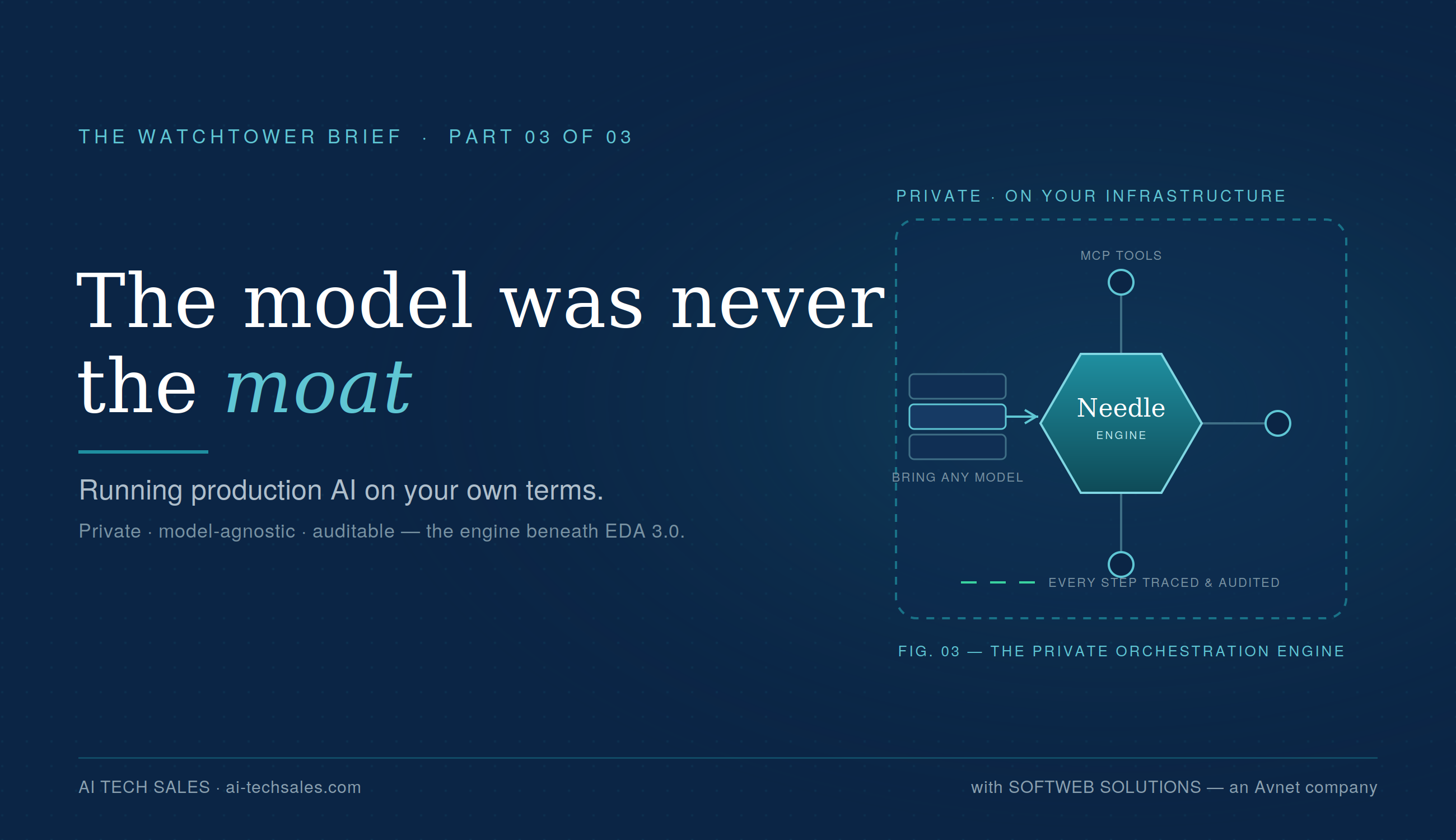
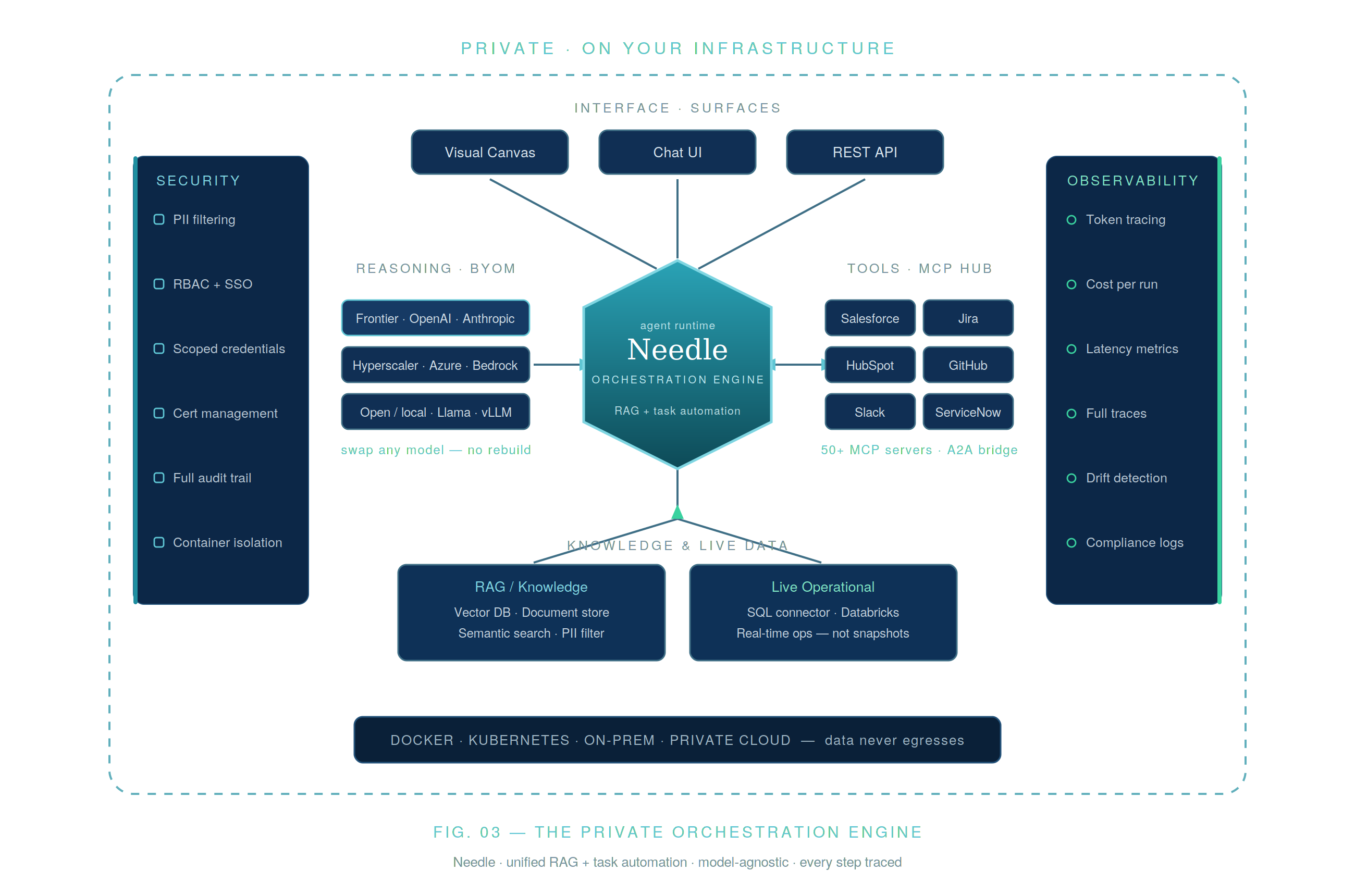 Strip away the noise and the required profile is specific, and it has to come as a set rather than a menu. Private deployment — the whole thing runs inside your infrastructure, on-prem or in your own cloud tenant, so the sensitive data never leaves your walls. Model-agnostic — bring whatever model is best this quarter, and switch without a rebuild. Unified — retrieval over your own knowledge and multi-step task automation across the systems engineering already uses, on one canvas, not two disconnected tools. Live, not stale — agents that query real operational data directly rather than answering from a vector snapshot of how the world looked last month. And observable — every step, every token, every cost, every retrieval logged and auditable, because production AI that you cannot see inside is not production AI; it is a liability with a chat box. Most tools give you one or two of these. Almost none lead with all five together, which is precisely why the loop in Part 02 and the governed artifact in Part 01 so often stall at the engine.
Softweb's Needle platform is built around exactly that set. It is a private-first, Docker-native orchestration layer — it runs on-prem or inside your own cloud tenant, with the data plane never leaving your control. It is model-agnostic by design, so the model is a setting, not a commitment. It collapses retrieval and task automation onto a single agentic canvas, and it is MCP-native, which in 2026 matters more than it sounds: with the Model Context Protocol now standard across the major model providers, Needle plugs into the tools engineering already runs — and into the systems of record where the BOM and the field loop live — without a fresh integration project for each one. It queries live data rather than stale snapshots. And it ships with the observability and PII controls built in at the runtime layer, not bolted on after an incident. The pitch is not a cleverer model. It is a governed engine that lets you put any model to work on your most valuable data without giving that data away.
That is also the bar Needle has to clear in the room, and it is worth being candid about it the same way we were about Softweb in Part 02: the argument only holds when the private-deployment story and the production evidence are actually on the table. Press any vendor — Needle included — on where the data lives, who can audit the agent, and what the bill looks like at ten times the usage. The differentiation is never the claim. It is the proof behind it.
Which brings us back to the pairing that runs through this whole series. A platform alone — however well-architected — still arrives without the domain context or the strategic frame: it can run agents, but it does not know which agents are worth running in a fab, a design org, or a field-quality team, and it has no credible door at the executive level. An advisor alone has the thesis and the relationships and cannot deploy a thing. Put them together and the two questions that decide these deals get answered in one motion. Do they understand our world? — that is the domain and the EDA 3.0 lifecycle framing AI Tech Sales brings. Can they actually run it safely on our data? — that is the private, governed orchestration Needle brings. It also moves the conversation out of the wrong room: an "AI tool" framed as an IT line item gets sent to procurement and benchmarked on per-seat rates; an engine for running governed AI on your own IP gets sponsored where strategic-capability decisions are actually made.
Hold any vendor — Needle included — to this list:
Strategic Takeaway
Don't buy a model, and don't buy a per-seat chat box. Buy the engine that runs governed AI on your own infrastructure — owned as a capability, by a partner who understands both your data and your domain.
The companies that win the AI-native era will not be the ones renting the largest model. They will be the ones who built a governed place to run any model against the data only they hold — the artifact from Part 01, the loop from Part 02, and the engine that finally makes both of them act. That engine has to be private, model-agnostic, and auditable. That is the case for Needle — and, as ever, for Needle with AI Tech Sales.
Explore the engine behind the series
See how Softweb's Needle runs production AI agents inside your own walls.
Explore Softweb →The Watchtower · AI Tech Sales · ai-techsales.com
Third in the series. Part 01 — "Why the simple BOM is now such a big deal" (the stakes). Part 02 — "Closing the field-to-engineering loop with a trusted IT partner" (the answer). Part 03 — this piece (the engine).