ICTK
PUF
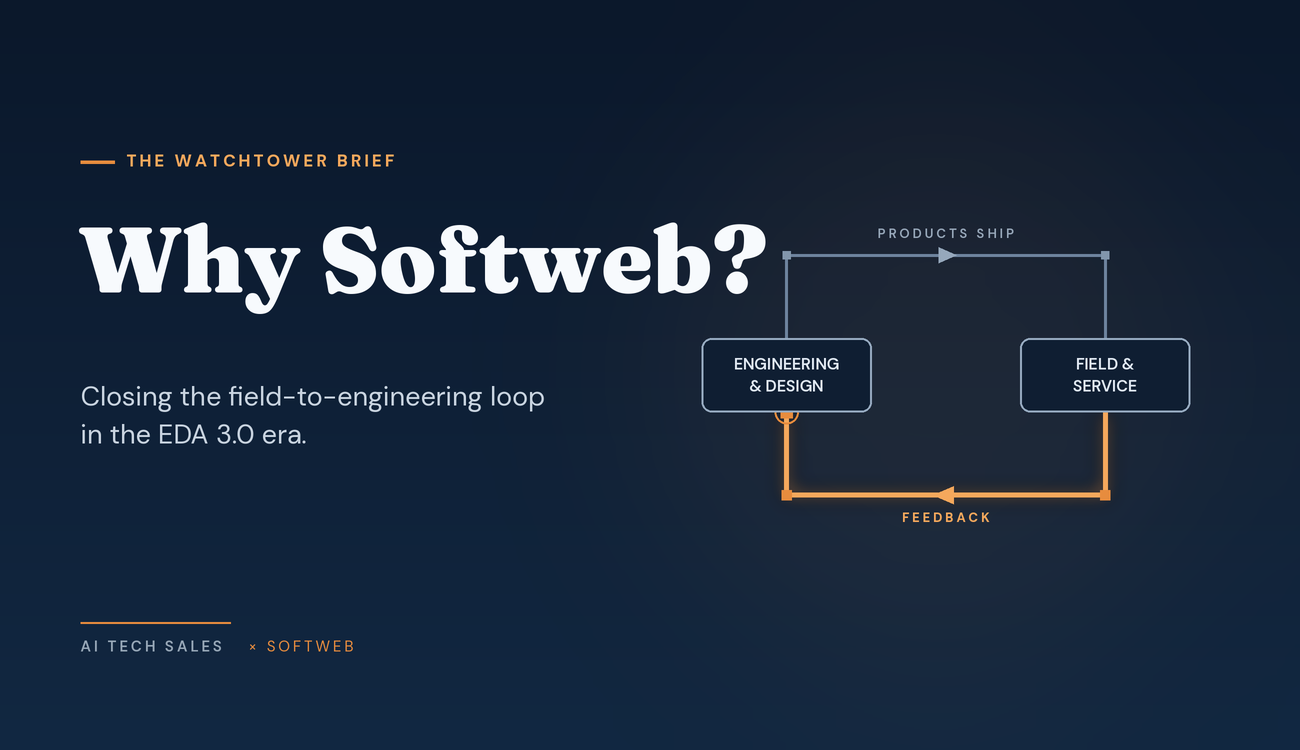


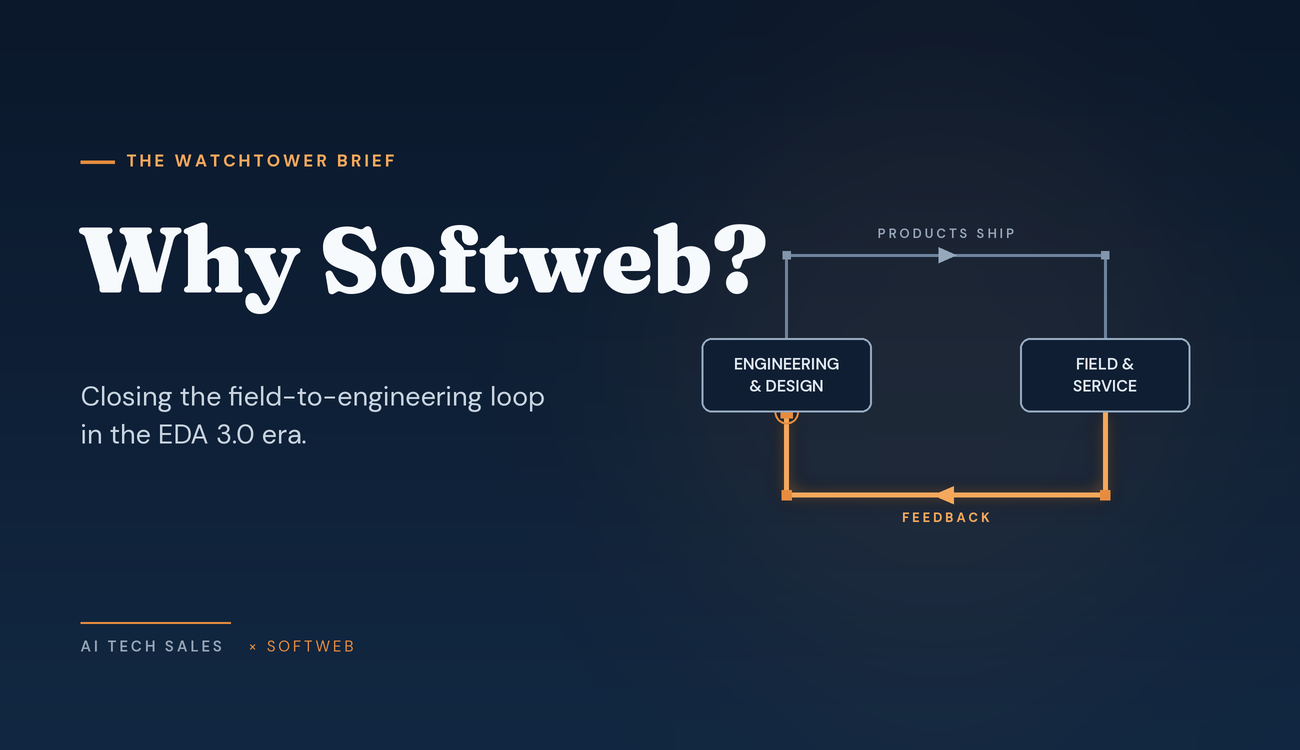
Every hardware company already owns the data to design a better product. Almost none of them can get it back to the people who design. That gap — not a shortage of tools, and not a shortage of hands — is the problem worth solving.
A modern semiconductor or hardware company is drowning in signal from the field. Returns and failure analysis. Service tickets and field-engineer notes. Test results, metrology, yield excursions, in-system telemetry. In theory this is the richest possible input to the next design — a continuous readout of how products actually behave once they leave the building.
In practice, that signal almost never reaches engineering in a form anyone can act on. It lands in a system of record — a Salesforce or a ServiceNow — and stops there. It sits in a manufacturing or test database that the design team doesn't query. It lives in spreadsheets, in tribal knowledge, or in the heads of field engineers who carry insight back to the roadmap by hand, one conversation at a time.
This is the unglamorous last mile of the AI-native lifecycle, and it is wide open at most companies in the industry. For two years the conversation about AI in chip and hardware development has been about what happens inside the tools: generative RTL, ML-driven place-and-route, AI-assisted verification, copilots in every seat. That progress is real. But it misses the deeper claim of EDA 3.0 — that the entire lifecycle, from intent through architecture, implementation, verification, physical design, and out to yield and the field, becomes a single learning system. And a learning system is only ever as good as its feedback loops. The loop from the field back into engineering is the one almost everyone has left open.
So why hasn't it been closed? Usually because the obvious answers look like they should work — and don't. Three of them come up in nearly every conversation.
“We already have a Salesforce or ServiceNow partner — won't they do this?”
This is the first reflex, and it confuses two very different jobs. The incumbent systems integrator is excellent at — and scoped for — keeping the platform running: workflows, case management, field-service dispatch, parts, entitlements. That work is essential, and it terminates at the edge of the platform. It is configuration of a system of record.
Closing the feedback loop is a different kind of work. It is a cross-system problem by definition. It has to read service and field signal, join it with test and manufacturing data, structure it into something AI-ready, and push it into the engineering data estate and the product roadmap. That path runs across systems the platform SI doesn't own and was never paid to connect. There is also an incentive wall: platform partners monetize seats and configuration hours, and a loop that lives partly outside the platform is orthogonal to that model. This is not a criticism of those partners. It is simply the wrong tool for this particular job. Your SI keeps the system of record running; the loop is the thing your SI was never scoped to build.
“Then couldn't we just stand up an offshore team?”
This is the honest objection, and it deserves an honest answer, because on the surface it is the cheapest path. Bodies give you hands. They do not give you a loop. Point a generic, rotating contractor team at this and you get a pile of code and no learning system. Three reasons the cheap-labor answer fails specifically here:
Domain. Knowing which field signal predicts which design or yield problem is hardware and semiconductor expertise, not generic development work. A team that doesn't understand failure physics, process variation, or yield will faithfully build pipelines that move noise.
Sensitivity. This is among the most proprietary data a hardware company owns — process detail, yield, failure modes, customer behavior. It is the last thing most companies will hand to undifferentiated, interchangeable offshore labor.
Ownership. Staff augmentation delivers code and then leaves. A feedback loop is a living system that someone has to own as an outcome — to tune, to defend, to improve as the products and the data change.
The real distinction is staff augmentation versus outcome ownership. You are not trying to buy hours. You are trying to buy a result that keeps producing value after the engagement ends.
So what kind of partner actually closes it?
Strip away the noise and the required profile is specific. It takes three things, and it takes them together: deep data and AI engineering — the ability to build the cross-system pipelines, the models, and the AI-ready data layer; domain fluency in hardware and semiconductors — enough understanding of the lifecycle to know what signal matters and what it means; and outcome ownership — accountability for a working, maintained loop and a named result, not a delivered codebase. That combination is rare. Most vendors have one of the three; a few have two. Almost none lead with all three, which is exactly why the loop stays open while everyone agrees in principle that it should be closed.
Why Softweb
Softweb Solutions fits that profile on the build-and-data side of the equation. It is an AI and data-engineering firm — an Avnet company — built around exactly this kind of cross-system, productized work: a GenAI framework of its own (Needle) rather than a blank-sheet statement of work; partnerships across Salesforce, Microsoft, AWS, Azure, Snowflake and Databricks, where this data actually lives; and documented delivery in semiconductor settings, including AI-driven defect detection and inspection feedback loops. The point is not a generic data shop with a nicer logo — it is a partner that arrives with a productized starting point and proof.
That is also the bar Softweb has to clear in every conversation, and it is worth being candid: the argument only holds when the productized IP and the evidence are on the table. Press any partner — Softweb included — for the specifics. The differentiation is never the claim. It is the proof behind it.
The combination is the differentiator
Which brings us to the part that is genuinely hard to copy: the pairing. A data partner alone — however capable — still walks in without the domain context, the strategic frame, or a credible door at the executive level. An advisor alone has the thesis and the relationships but cannot build anything. Neither clears the bar by itself. Domain without build is a slide deck. Build without domain is plumbing that moves noise.
Put them together and the two killer questions get answered in a single motion. Do they understand our world? — that is the domain and the EDA 3.0 framing AI Tech Sales brings. Can they actually build it? — that is the data and AI engineering Softweb brings. The platform SI can field delivery but not domain or strategy. The offshore shop can field hands but not product or point of view. The combination of domain-plus-strategy and build-plus-platform is exactly what neither of them can put in the room. It also changes the category of the conversation: a loop framed as an IT cost line gets routed to procurement and benchmarked on rate cards; a loop framed as a strategic capability — turning field learning into design advantage — gets sponsored and funded at the level where that kind of decision is actually made.
What to demand from any partner
If you take nothing else from this, take the checklist. Hold any partner — Softweb included — to it:
Explore the partner behind the seriesSee how Softweb builds AI and data into the engineering loop.
Explore Softweb →