A View from the Watchtower · Part Three
Requirements aren't a document you sign and file. Inside EDA 3.0 they are the living spine of the program — and we're proud to welcome Jama Connect to the portfolio.
We have spent two posts on requirements because we believe something the industry has been slow to say out loud: in EDA 3.0, requirements are not the paperwork around the design. They are the design's first layer — and the thread that holds every layer after it together.
01 — The stack
The six layers, and the one everyone skips
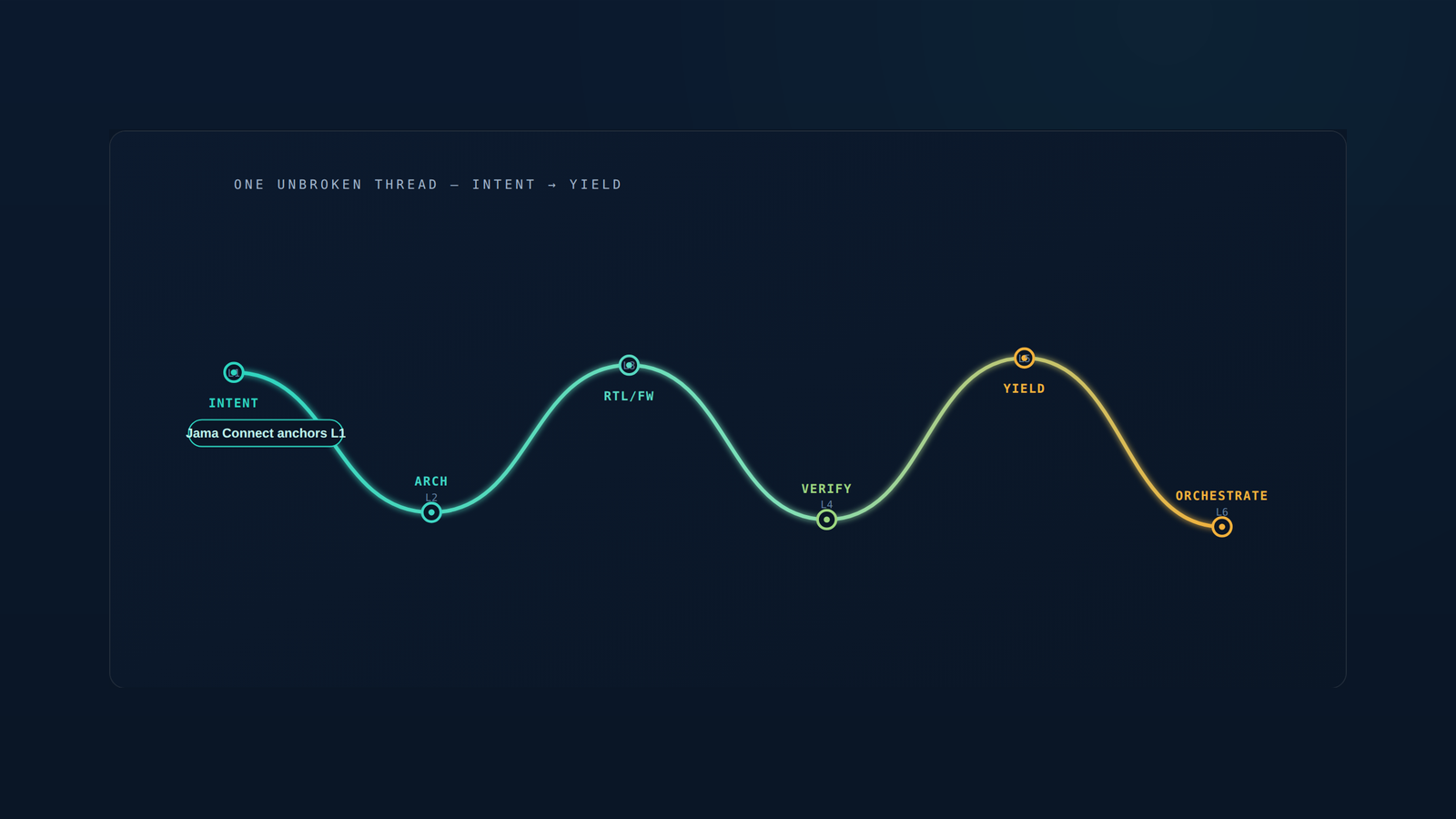
Our thesis is simple. EDA 2.0 was tool-centric, siloed, and human-driven — value measured in how fast a single tool ran. EDA 3.0 is AI-native lifecycle orchestration from intent to yield, across six layers: L1 Intent and Requirements, L2 Architecture and Modeling, L3 RTL and Firmware, L4 Verification, L5 Yield and Physical, and L6 AI Orchestration. Value is measured in outcomes — time-to-market, yield, margin — not tool speed.
EDA 2.0 vs. EDA 3.0
| Dimension |
EDA 2.0 |
EDA 3.0 |
| Shape |
Tool-centric, siloed, human-driven |
AI-native lifecycle orchestration |
| Layer 1 (Intent) |
Assumed — lives in a PDF nobody reopens |
A living, traceable spine (Jama anchors it) |
| Measured by |
How fast a single tool runs |
Outcomes — time-to-market, yield, margin |
| The thread |
Breaks at every hand-off |
Continuous — intent → yield → intent |
Almost all of the industry's attention, and nearly all of its tooling, lives in layers two through five. Layer one — what the chip is actually supposed to do, for whom, and how we will prove it — is the layer everyone assumes someone else owns. That is exactly why programs drift. A simulator can tell you the design does what the RTL says. It cannot tell you the RTL says what the stakeholder needed. Only the requirements layer can — and only if it is alive.
02 — The thread
One unbroken line, intent to yield
Picture a single thread running up the stack. It starts as a stakeholder need at L1, becomes an architectural decision at L2, an implementation in RTL or firmware at L3, a verification plan and result at L4, a physical and yield outcome at L5, with AI orchestrating the whole flow at L6. When that thread is continuous, a change at any layer is instantly legible everywhere else. When it is broken — when L1 is a PDF nobody has reopened since kickoff — every layer beneath it is flying on stale intent.
Live Traceability is that thread. It is why Jama Connect is the right anchor for Layer 1: it does not merely store requirements, it keeps them connected to everything downstream as the design moves. That is the difference between a requirements document and a requirements spine.
| "Intent to yield, with the thread unbroken. That is the promise of EDA 3.0 — and requirements are where it starts." |
03 — The partnership
Why AI Tech Sales partnered with Jama
We are an EDA 3.0 lifecycle-orchestration firm. Our job is to connect the layers, not to sell another point tool. We had a strong Layer 1 argument and a gap in the portfolio: the category-defining platform for living requirements. Jama Connect is that platform — and we are proud, finally, to welcome it to the AI Tech Sales portfolio.
The fit is almost uncomfortably good. Jama is Portland-built, like us. It owns and named the Live Traceability category. It has just shipped a semiconductor-specific solution. And it is leaning hard into exactly the AI-native direction our thesis predicts — making requirements the trustworthy context layer beneath AI-assisted engineering. When the platform you would have drawn on a whiteboard turns out to already exist, you stop drawing and start partnering.
04 — The payoff
What it means for our customers
For the teams we work with, the translation is concrete. Requirements become the living spine of the program — queryable, connected, and current, instead of a document you sign and file. The plan keeps pace with the design — a change anywhere surfaces everywhere, before it becomes a respin. Safety, security, and quality become one system — properties of a single traceable program, not three separate audits. And AI finally has trustworthy intent — the one thing AI-assisted engineering cannot manufacture for itself: a traceable source of truth to ground it.
|
The operator's read
If you are carrying a modern silicon program on documents and spreadsheets, that is not a process you have — it is a risk you are holding. We should talk.
|
Book a briefing →
The Jama Series · A View from the Watchtower
Part 1 — The Spreadsheet Was Never the Plan
Part 2 — Functional Safety Was the Front Door, Not the House
Part 3 — From Intent to Yield: Why We Partnered with Jama (you are here)