A View from the Watchtower · Part Two
Jama Connect earned its name in safety-critical development. The reason it matters to every silicon team is far broader than compliance with a safety standard such as ISO 26262 or IEC 61508.
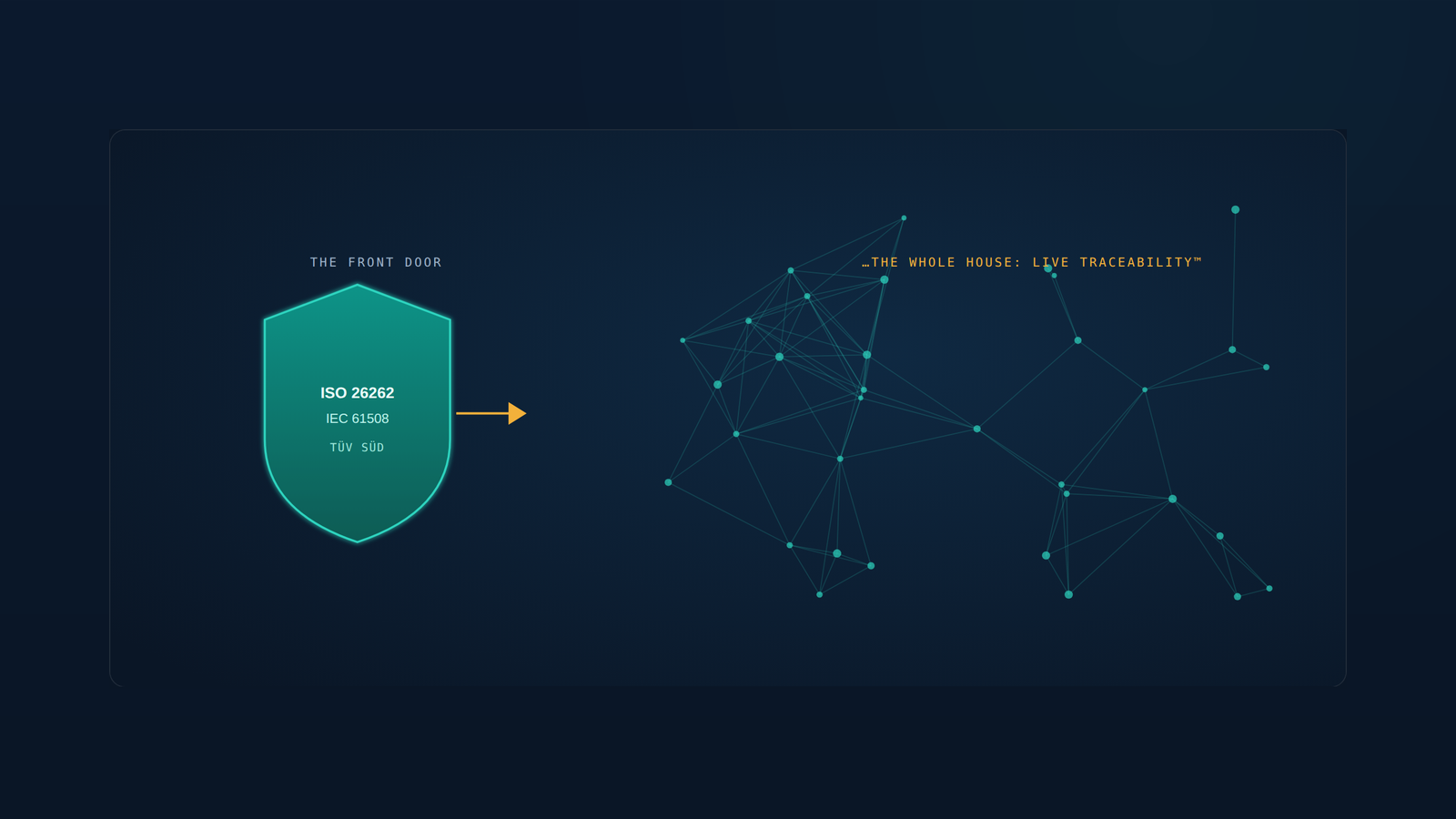
If you already know Jama Connect, you probably met it through functional safety. That is the front door most people walk through, and it is a very good door. But mistake the door for the house, and you will badly underestimate why this platform matters to silicon teams who have never written an ISO 26262 work product in their lives.
01 — The front door
Why functional safety built the trust
Jama earned its reputation in the most unforgiving corner of engineering: safety-critical development, where a missed requirement is not a bug, it is a recall — or worse. The platform ships pre-built frameworks aligned to ISO 26262, IEC 61508, and IEC 62304; it holds TÜV SÜD qualification for safety-related development; and it offers a Functional Safety Kit with pre-validated workflows and a certificate, so teams start from a compliant process instead of an empty template.
That matters because functional safety is the hardest possible test of a requirements tool. FuSa demands an unbroken evidence chain — hazard to safety requirement to design artifact to verification result — maintained continuously as the design changes, not stitched together the week before an audit. A platform that can survive an ISO 26262 audit can survive almost anything you throw at it.
|
3
safety standards Jama ships pre-built frameworks for — ISO 26262, IEC 61508, IEC 62304
|
100M
items of scale — engineering system-of-record territory, not a documentation tool
|
Dec ’25
purpose-built Jama Connect for Semiconductors shipped
|
02 — The discipline
Why it travels beyond the safety island
Here is the part most observers miss. The discipline that functional safety forces on you is exactly the discipline modern silicon now needs everywhere — not just inside the safety island.
Every SoC team now lives with pressures that used to be unique to automotive: concurrent hardware, software, and firmware; third-party IP of uncertain pedigree; supply-chain qualification; security overlays; and change that never stops. The thing that makes FuSa hard — keeping intent, design, and verification connected while all of it moves — is the same thing that makes any complex chip hard.
Jama's answer is Live Traceability™: the ability to see the complete, current upstream and downstream picture for any requirement, no matter how many siloed tools and teams it spans. Suspect-link management surfaces the blast radius of every change the moment it lands. That capability was built to satisfy safety auditors. It turns out to be just as valuable for a power-management requirement that has nothing to do with safety at all.
| "FuSa is how Jama proves the platform works. It is not the limit of what the platform is for." |
03 — The house
Way, way more than FuSa
Look at where Jama has actually taken the product and the "front door" framing becomes obvious. In December 2025 the company shipped a purpose-built Jama Connect for Semiconductors solution — pre-configured for fabless companies and IDMs, with a procedure guide that runs from stakeholder MRDs and system-level PRDs all the way through validation and verification. It is a recognition that semiconductor requirements are their own discipline, not a borrowed automotive template.
Crucially, that solution pulls traceability upstream, into EDA and verification tools, instead of bolting it on at the end. And it does so without forcing engineers out of the tools they already use: requirements stay live across Jira, GitHub, GitLab, Azure DevOps, and even Excel through best-of-breed integration rather than replacement. Jama has also made the case to semiconductor teams directly for retiring the document-based process.
Then there is the AI turn, which is where this gets genuinely interesting for us. Jama now positions Jama Connect as the product context layer for AI-driven development — the curated, traceable source of truth that makes LLM-assisted engineering trustworthy instead of merely plausible. AI-generated requirements and test cases are only ever as good as the context they are grounded in. A living requirements platform is precisely where that context lives. Add the engineering reality — scale to 100 million items, SOC 2 Type II — and this stops looking like a documentation tool that grew up. It is an engineering system of record.
|
The operator's read
The discipline functional safety forces on you is the discipline every modern silicon program now needs — whether or not a single line of it is safety-related.
|
Functional safety opened the door. What is behind it is a requirements layer built for the entire modern silicon lifecycle. In the final post I connect that layer to the bigger picture — how requirements flow through all six layers of EDA 3.0, and why we partnered with Jama to anchor it.
The Jama Series · A View from the Watchtower
Part 1 — The Spreadsheet Was Never the Plan
Part 2 — Functional Safety Was the Front Door, Not the House (you are here)
Part 3 — From Intent to Yield: Why We Partnered with Jama