
ICTK
PUF
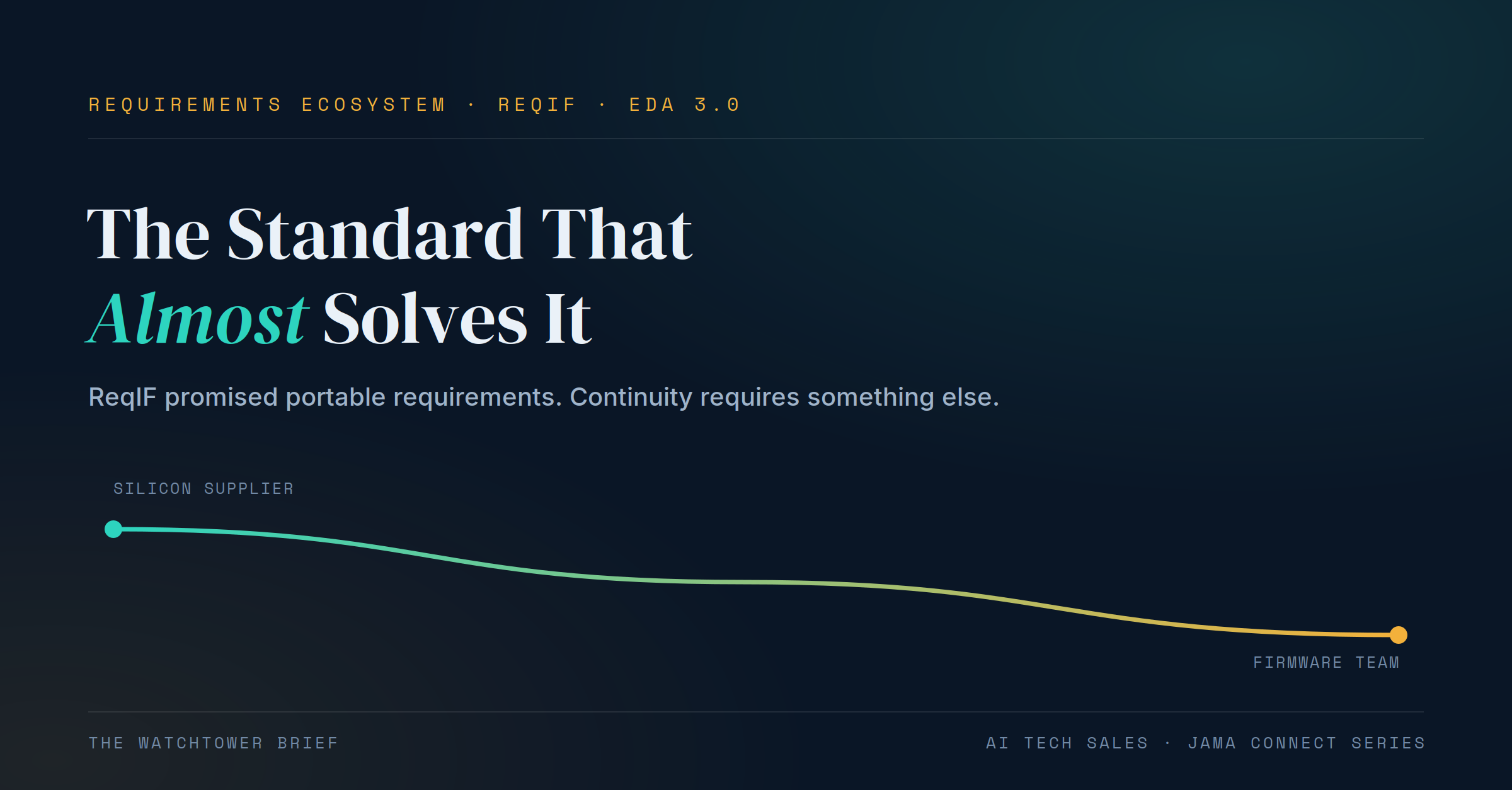

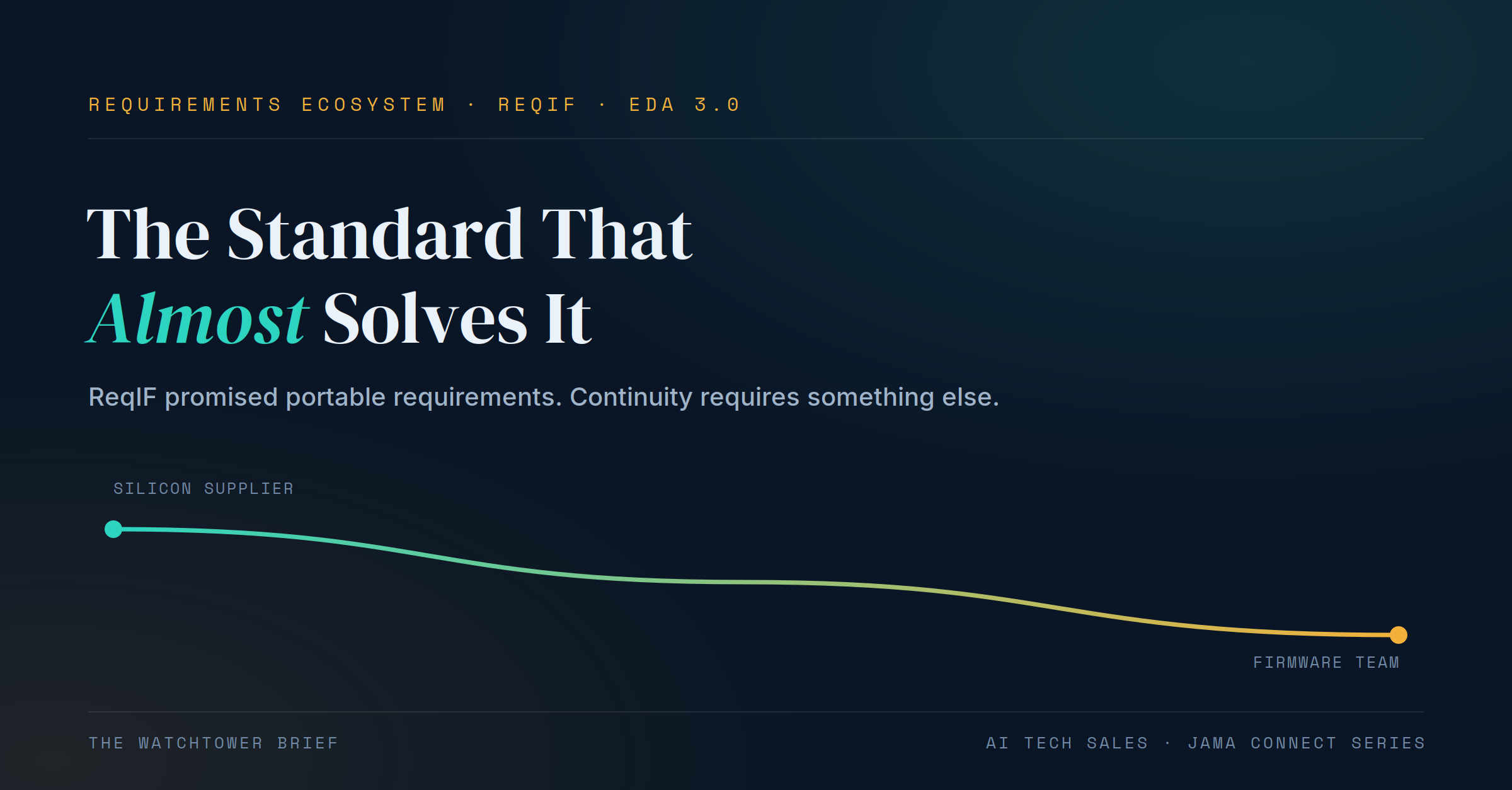
Requirements don't stop at tape-out. Once silicon ships, the specification keeps moving — downstream, into a customer's firmware and system integration teams, who need to know exactly what the part promises before they can build on top of it. This is the same handoff problem the industry solved internally years ago, when spreadsheets and PDFs gave way to real requirements management. Except this time the boundary isn't a department. It's a company.
ReqIF exists because someone recognized this exact problem. Originally developed in 2004 by a consortium of German automotive manufacturers, it was handed to the Object Management Group and adopted as a formal standard in 2011 — an open, XML-based format built to move requirements between different tools, different vendors, and different companies without losing the data along the way. It's a genuine, hard-won piece of industry infrastructure, and today almost every serious requirements management tool supports it in some form.
ReqIF defines a metamodel, not a guarantee. It specifies how requirements can be structured and moved — but a successful exchange still depends on both sides agreeing on the same underlying data model: the same attribute definitions, the same enumerations, the same custom types. In practice, those rarely match exactly between two organizations, let alone two tools. Cross-vendor exchange usually means a mapping exercise every time a file moves, and even careful mapping tends to lose some fidelity in workflow states, custom attributes, or linkage. The standard is open. That's precisely why it's open to interpretation.
Where this breaks down cleanly is Jama-to-Jama. When both sides of a relationship run the same platform, there's no translation step to get wrong — attributes, links, history, and status carry across natively, because nothing has to be re-expressed in an intermediate format. It's not a clever integration. It's the absence of one.
|
A file format can carry data across a boundary. It can't carry a relationship. — on the limits of interchange |
For the relationships that matter most — a supplier whose specifications govern dozens or hundreds of downstream design teams — the answer isn't a better ReqIF mapping. It's removing the export step entirely. A shared or connected Jama Connect instance gives the downstream customer live visibility into the same specification, the same traceability thread, the same status, in real time, rather than a snapshot that ages the moment it's exported. This is the kind of arrangement that suits large, enterprise-scale licensing relationships best — where the volume and duration of the partnership justifies building shared infrastructure rather than repeating a file exchange on every revision.
This is the quieter half of the EDA 3.0 argument. Requirements continuity isn't just an internal efficiency story inside one company — it's the connective tissue between every company in a design's supply chain. Treat it as shared infrastructure, and traceability survives the handoff from silicon to system. Treat it as a file format problem, and every boundary becomes another place intent gets lost in translation.
|
The Watchtower Brief AI Tech Sales is Jama Software's outsourced go-to-market partner for the semiconductor market, helping design teams treat requirements as the foundation layer of the EDA 3.0 stack rather than an afterthought. If your organization sits on either side of this boundary — as a supplier whose specs travel downstream, or a design team piecing together requirements from a dozen sources — we'd welcome the conversation. |