
chiplets
Photonics
yieldWerx

|
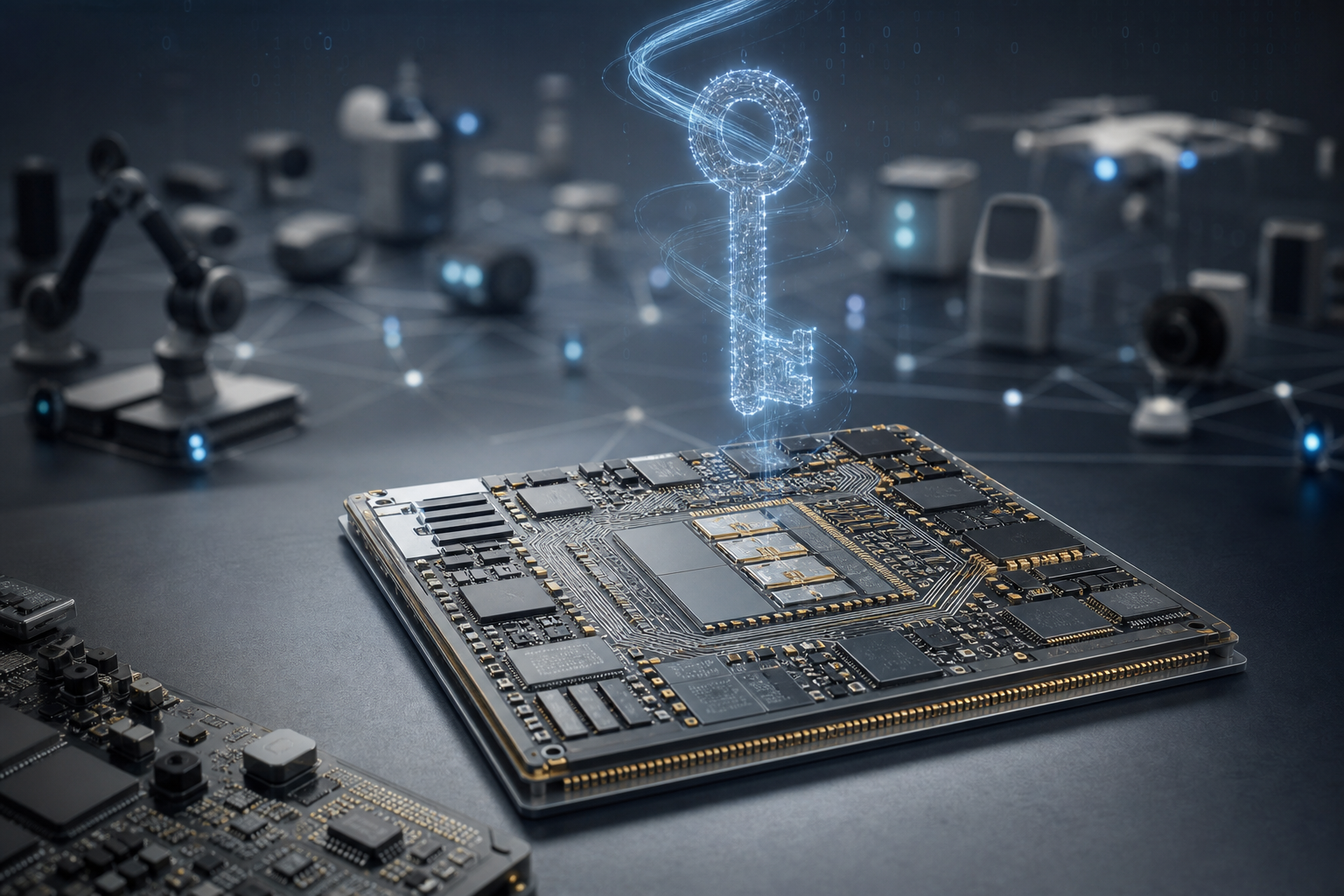
WATCHTOWER BRIEF · HARDWARE SECURITY · CHIPLETS & UCIe AiT × ICTK · A VIEW FROM THE WATCHTOWER Every root of trust starts with a secret. For most chips, that secret is generated somewhere else, injected on a test floor, and stored in memory that an attacker can eventually reach. A physically unclonable function asks a different question: what if the chip simply was its own key?
When I was sourcing third-party IP at Intel, the security blocks were always the hardest conversations. Not because the cryptography was difficult to evaluate, but because nobody could answer a simple question cleanly: where does this device's identity actually come from, and who else has touched it on the way? The usual answer involves a hardware security module on a test floor, a key injected into one-time-programmable memory or flash, a provisioning flow that has to be trusted at every manufacturing partner, and a stored secret that must be protected for the life of the product. It works. It is also expensive, slow to scale across suppliers, and a standing target for anyone with a microscope and time. Why is hardware identity getting harder now?Three shifts are landing on security architects at the same time.
Each of these on its own would justify a fresh look at how identity is anchored. Together they make the provisioned, stored-key model look like what it is: a manufacturing workaround that has been asked to carry more and more weight. We touched on the chiplet side of this in Old Is New Again and in our EDA 3.0 work, where trust becomes a property that has to follow a design across companies, not just across a die. The policy side is covered in Where Trust Ends, And Assurance Begins.
What is a physically unclonable function?A PUF uses the tiny, uncontrollable physical differences that every manufacturing process leaves behind. No two dies are identical at the nanometre scale, so a circuit that measures those differences produces a response unique to each chip. Feed that response into a key-derivation step and you have a device key that was never generated externally, never injected and never stored. Power the chip down and the key is gone; power it up and the silicon regenerates it. The idea is not new. What has changed is that PUFs have moved from research papers into commercial IP blocks, and the differences between implementations now matter to anyone putting one into a product. How should a security architect evaluate a PUF?
The last question deserves a sentence of its own. The market leader by distribution in SRAM-based PUF IP was acquired by one of the big EDA vendors in 2024. That is not a criticism of the technology. It does mean that for many design teams, the company supplying their synthesis and verification tools could also supply the anchor of their security architecture. Some teams will welcome that consolidation. Others, particularly those selling security themselves, will want an independent option. Our guide to managing commercial semiconductor IP covers why supplier concentration is worth thinking about early. What makes a via-based PUF different?ICTK's vPUF takes a different physical source of randomness from SRAM start-up states. It uses the random formation of via holes between metal layers during standard chip fabrication: whether a given via connects or not is decided by process variation, so the pattern is unique to each die and fixed once it is made.
Those characteristics line up with the three pressures above. Automotive qualification answers the robustness question for vehicles and harsh environments. Low overhead suits edge AI and tag-scale devices. A die-level identity that needs no provisioning step is a natural fit for chiplets that must authenticate each other inside a package. Where does this matter first?
Frequently asked questionsWhat is a physically unclonable function (PUF)?A PUF is a circuit that derives a unique, repeatable response from the random physical variations in each chip. That response can be turned into a device key that is regenerated on demand rather than stored, so there is no secret sitting in memory to extract. How is a PUF different from a key stored in OTP or flash?A stored key is generated outside the chip, injected during manufacturing and kept in non-volatile memory for the life of the device. A PUF key is derived from the silicon itself each time it is needed, removing the injection step and the stored secret. What is ICTK vPUF?vPUF is ICTK's via-based PUF IP. It uses the random formation of vias between metal layers during standard fabrication to give each die a unique identity, with no external key storage, and is AEC-Q100 qualified. Why does post-quantum cryptography increase interest in hardware roots of trust?Post-quantum algorithms protect data against future quantum attacks, but they still depend on keys that must be generated and held securely. Policy pressure to adopt PQC brings fresh scrutiny to how those keys are anchored in hardware. Why do chiplets need hardware identity?In a chiplet design, dies from different sources share a package and communicate over standard interfaces. Each die needs to authenticate itself to the others so that a counterfeit or tampered chiplet can be detected. Who represents ICTK in North America?AiT is a North American sales representative for ICTK's vPUF IP. AiT represents ICTK in North America. If your team is weighing how to anchor device identity on its next platform, I would be glad to compare notes and to set up a technical session with ICTK. Reach me directly at simon@ai-techsales.com. FURTHER READING ON THE WATCHTOWER BRIEF
Sources: ICTK product and certification information and the ICTK and BTQ joint chip announcement (July 2026), per ICTK. Product capabilities described per ICTK. AiT is a North American sales representative for ICTK. |
|||||||||||||||||||||||||||||||||||||||||||||||